

Contacts

92 Bowery St., NY 10013

thepascal@mail.com

+1 800 123 456 789

Tag: EDUCATION

EVENTSIMPORTANCE OF PLAYPOLICY

Protect Play, Protect Childhood — District-Level Roundtable, Ahilyanagar

12  years of on-ground work reflected in a landmark decision by the Ahilyanagar Zilla Parishad: all schools across the district began the new academic year with an Hour of Play—and why this marks an important milestone for play-integrated education in Maharashtra.

On  11 June 2026, the International Day of Play, we convened  Protect Play, Protect Childhood, a district-level roundtable with our partner, Snehalaya at the Ahilyanagar Gymkhana. The conversation brought together government leaders, educators, civil society organisations and CSR partners around a shared question: 

What would it take for every child to experience play as part of school?
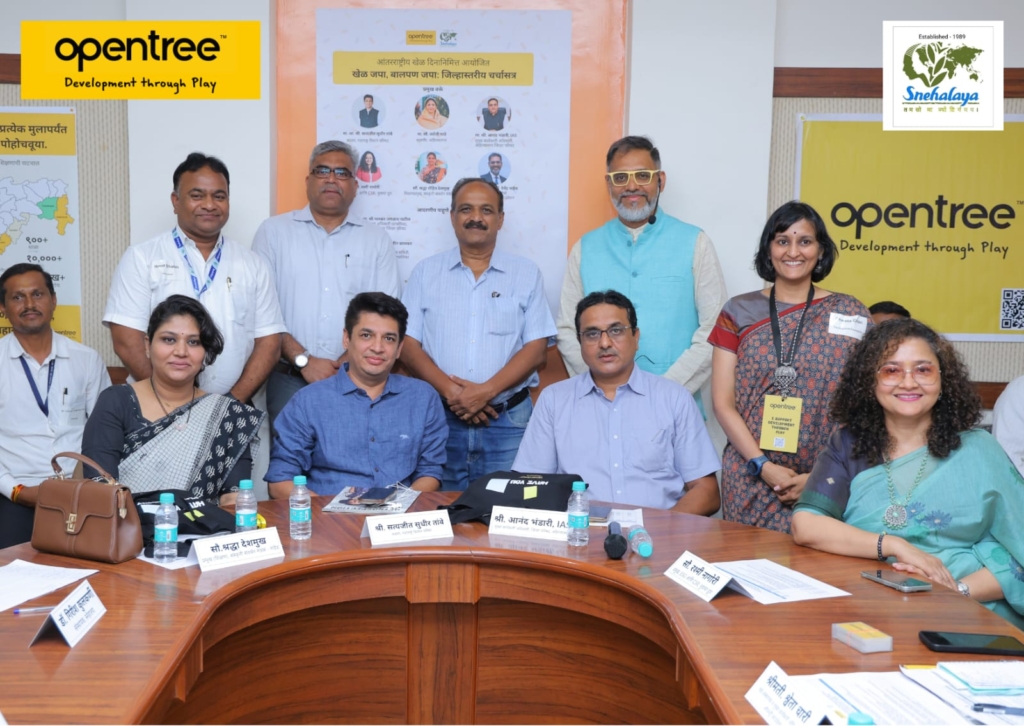
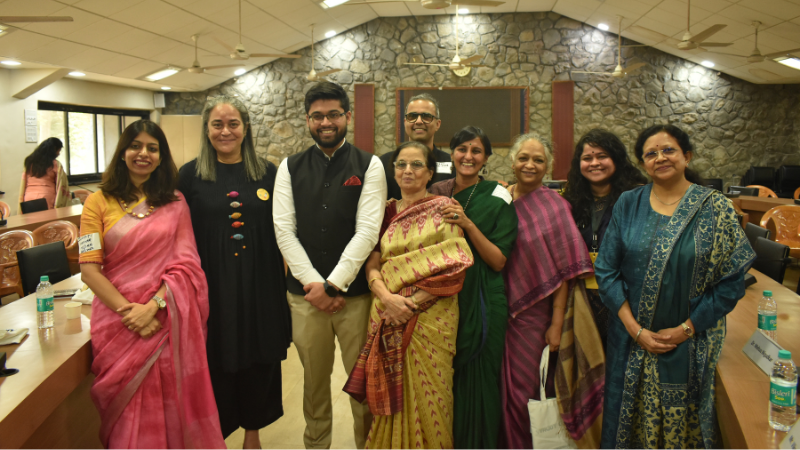
The room included Shri. Anand Bhandari, IAS, CEO, Ahilyanagar Zilla Parishad, Shri. Satyajeet Sudhir Tambe (Member of Legislative Council, Maharashtra), Ms. Rashmi Nagori (Head, ESG and CSR, Nuvama Group), Mrs. Shraddha Deshmukh and Mr. Rohit Deshmukh (Sanskriti Samvardhan Mandal, Nanded), Ms Shweta Chari (Co-founder and CEO, TOF), Dr. Girish Kulkarni (Founder, Snehalaya), and Mr. Devendra Naik (Founder, NoMoBo, and Trustee, TOF), who moderated the discussion.

Rather than focusing on a single programme or intervention, the roundtable built the case for play-based learning from four complementary directions: what children need to thrive, how rapidly childhood is changing, what schools are meant to offer beyond academics, and what it takes for change to last inside public systems.

The discussion culminated in the declaration of a district-wide initiative by Shri Anand Bhandari, IAS, CEO, Zilla Parishad, Ahilyanagar.

पहिला दिवस शाळेचा, एक तास खेळाचा. (Day 1 of school, 1 Hour of Play)
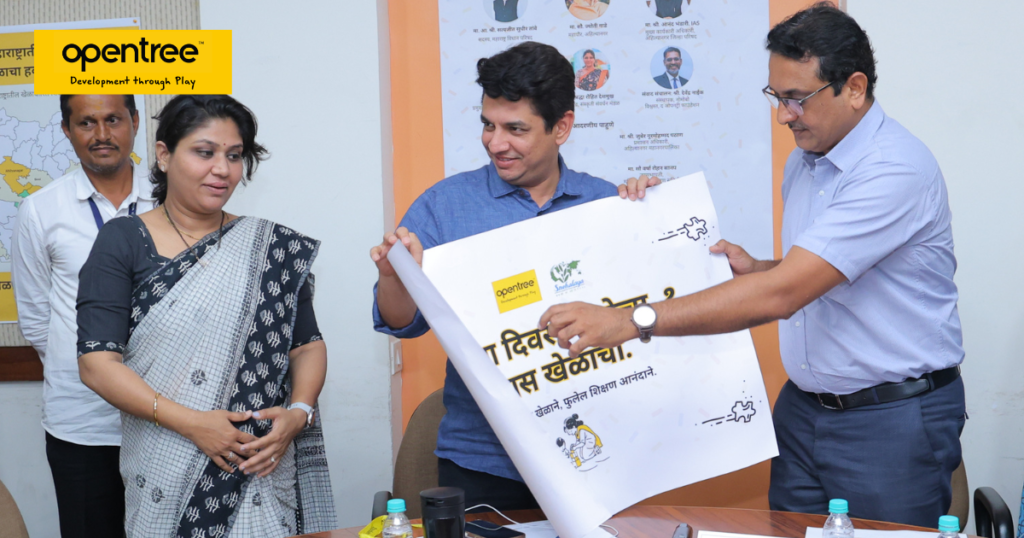
With that announcement, every government school in Ahilyanagar was mandated to celebrate the new academic year with an hour of play.

On 15 June 2026, children across 1000+ Zilla Parishad schools in Ahilyanagar were welcomed to school with a joyful hour of Play, a day they will cherish for a long time to come. Principals, teachers and school staff enthusiastically planned games and activities, decorating classrooms with posters and banners. 
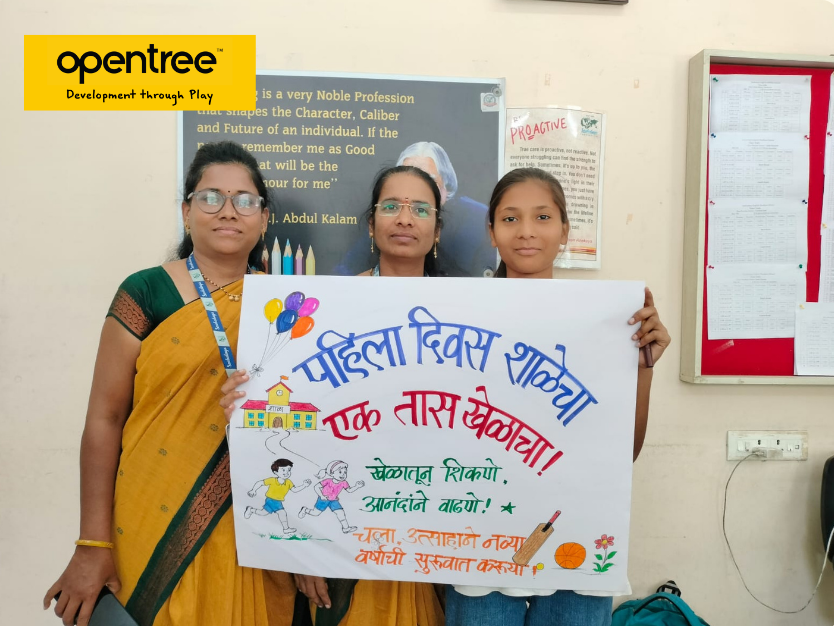
TOF’s team collaborated with all Block Education and Block Development Officers across all 14 blocks to support implementation, drawing on more than 350 free activities from Playpedia.in, TOF’s open-source library of low-resource play ideas. Following the success of the initiative, Shri Bhandari also directed that schools across the district undergo Playpedia sensitisation sessions led by TOF.

For The Opentree Foundation (TOF), the roundtable and the पहिला दिवस शाळेचा, एक तास खेळाचा initiative (Day 1 of school, 1 Hour of Play) represent a powerful, significant step in its journey towards realising the Right to Play in India. This was a historic moment –  the first time a government institution in Maharashtra  had taken ownership towards integrating Play-based learning into schools at a scale — the systemic shift TOF has been working towards for over two decades, reflected in the room through voices across the system.

The roundtable began with a welcome by children from Snehalaya’s Balbhavans, setting the tone for a discussion centred on children’s voices and experiences.

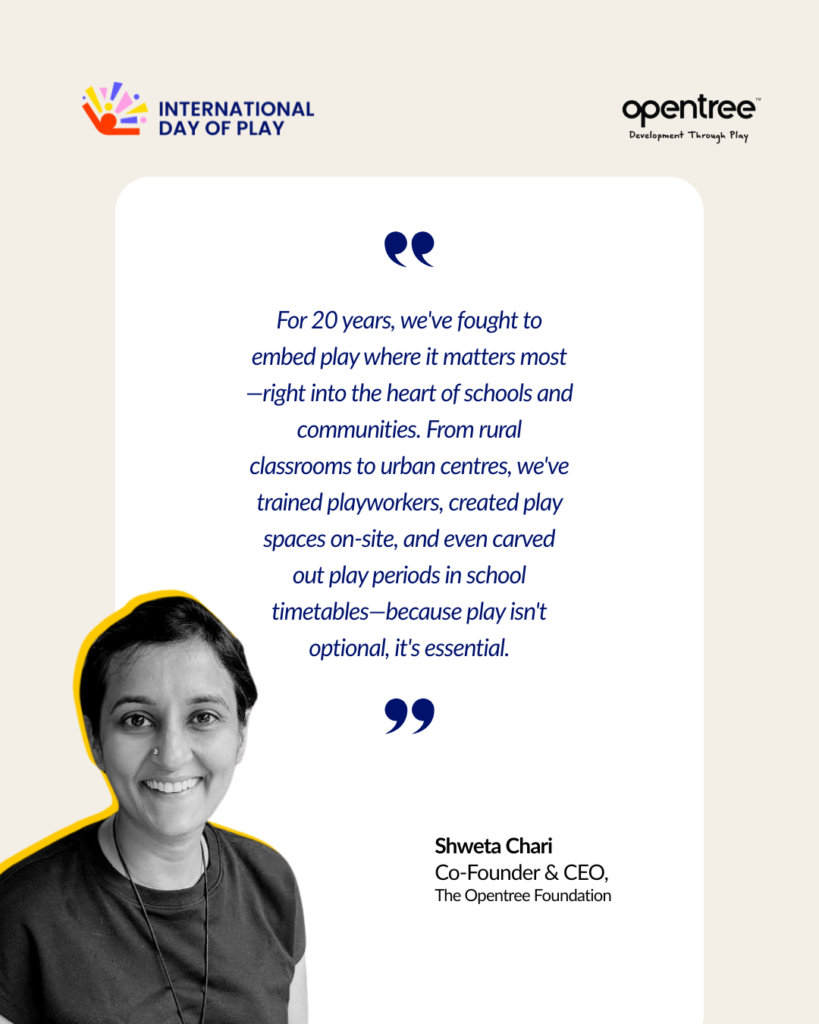
Shweta Chari, Co-founder and CEO of TOF, argued that play is not an extracurricular activity, but the foundation on which children develop the creativity, empathy and problem-solving skills needed to become thriving adults as well as contributing citizens. 

Shri. Satyajeet Sudhir Tambe reflected on the rapidly changing nature of childhood, emphasising that schools must intentionally nurture these abilities, while Shri Anand Bhandari shared his vision of schools as places of joy, creativity and confidence.

Shri Satyajeet Sudhir Tambe spoke about the speed at which childhood is changing, arguing that schools must evolve just as quickly.

“Any muscle you don’t use stops working. If we don’t give children regular opportunities to use their cognitive and creative skills, those skills will disappear.”

-Shri. Satyajeet Sudhir Tambe

“Schools should be the heart of a child’s happiness—spaces of joy, creativity and confidence, where every child grows up with a teacher they remember all their life.”

– Shri. Anand Bhandari, IAS, CEO, Ahilyanagar Zilla Parishad


Rashmi Nagori, Head of ESG and CSR at Nuvama Group, challenged the false divide between play and education. She called for play to be recognised as an essential investment in children’s learning and development, reminding the room that “Play is learning.”

Bringing these ideas into practice, TOF’s long-standing partners, Snehalaya and Sanskriti Samvardhan Mandal, shared how Play2Learn had transformed classrooms by replacing fear with trust, strengthening teacher-child relationships, and helping children engage more confidently in learning. As Dr. Girish Kulkarni, Founder of Snehalaya, reflected, “Nothing we tried worked until Play reached these children—it was as though Play helped us find a way to connect with them.”

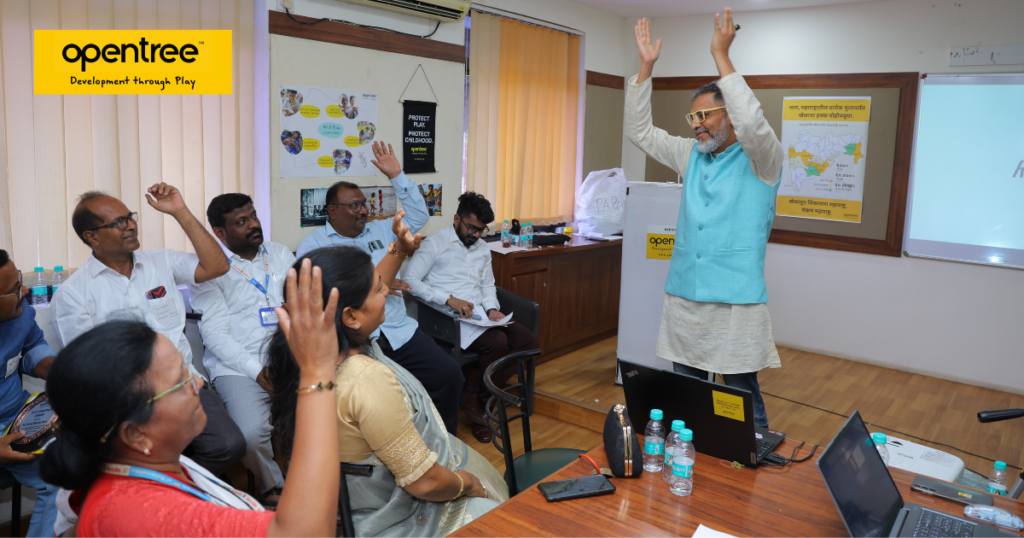
The roundtable was also the first ever felicitation of Ahilyanagar’s Play champions and Leaders – teachers and principals from our  partner schools who have embedded Play-based learning in classrooms across Ahilyanagar.

The session concluded with an interactive Play reflection led by TOF Trustee Devendra Naik, inviting participants to collectively envision the future of Play-based learning in Maharashtra.
The roundtable also opened new systemic pathways at a district and state level:

  • Expanding the Play2Learn programme  Municipal Council schools in Sangamner
  • Embedding play-based learning into the district’s School Development Plans
  • Introducing TOF’s School Readiness Play Programme into Anganwadis and expanding Play2Learn into secondary schools in the district
  • Deepening partnerships with Gram Panchayats and School Management Committees.
  • Possible alignment with  Maharashtra’s proposed Future Generations Wellbeing Bill with evidence on play and child wellbeing.

Each of these pathways represents an opportunity to move closer to institutionalising Play-based learning in government systems, and towards making Maharashtra the first state in India to have a government-adopted, scalable model for Play-integrated schools. 

For over two decades, The Opentree Foundation has worked to demonstrate that Play is fundamental to how children learn, grow and thrive. The roundtable and declaration in Ahilyanagar represent a district where years of evidence, partnerships and trust have translated into system-wide action.

The vision has always been larger than a single programme or district. It is to build a future where every child in India, regardless of where they are born or which school they attend, experience learning that allows them to be themselves, feel joyful, curious, excited, and prepares them to thrive as adults in their future. 

Ahilyanagar has shown that this future is possible. Now, the work begins to make it the norm, across Maharashtra, and India. 
EVENTS

Rediscovering Play: Insights Shaping Play Summit 2025

As we look ahead to Play Summit 2025, themed Finding Play, our global roundtable — Rediscovering Play: Stories of Transformation — set the perfect stage for a deeper, collective exploration of how play lives in classrooms, communities, and everyday moments. This conversation was not just a reflection on what play means, but an invitation to reimagine what learning, childhood, and human connection can look like when play takes its rightful place at the center.

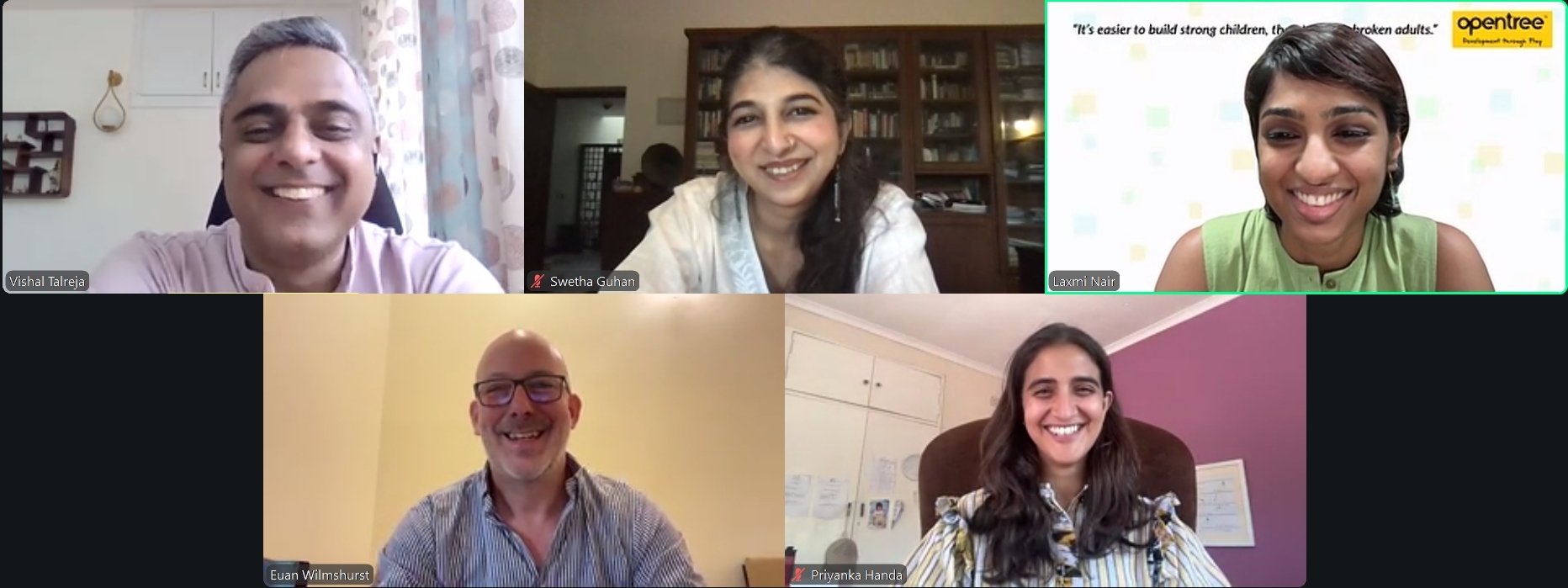
Hosted by The Opentree Foundation, the roundtable brought together four global champions of play whose work spans early childhood education, community wellbeing, youth development, policy advocacy, and systemic reform: 

  • Vishal Talreja
    Co-founder, Dream a Dream (India)

  • Swetha Guhan
    Co-founder & Director, Key Education Foundation (India)

  • Priyanka Handa
    Co-founder, Learn to Play (Botswana)

  • Euan Wilmshurst
    Founder & Principal, KW Strategy (UK)

The session was moderated by Laxmi Nair, Director, Programme Development at The Opentree Foundation, who led the panel through personal stories, field insights, and critical reflections on the role of play in reshaping systems.

With over 200 participants joining live from across the US, UK, Germany, Nigeria, Tanzania, Vietnam, and many more countries, the conversation reflected a truly global perspective for rediscovering play as a right, a pedagogy, and a powerful social connector.

Play Is Not a Luxury, It’s a Low-Resource Lifeline

Setting the tone for the discussion, Euan shared a simple but powerful truth: “Even in the hardest times, even in the toughest circumstances, play does not have to be a luxury. It’s very low resource. Play is very easy to do.”

Across his global work, he has seen families and communities rely on play as a stabilising force, especially during moments of crisis. But he also spoke about the structural barriers that keep play out of children’s reach. In many urban areas in England, he noted, the only neighborhood playgrounds close during school holidays. Some even turn into car parks.

“It’s almost unbelievable when you say it out loud, but it shows why we need coalitions across communities. When people unite, for safer streets, clean public spaces, or play, the stories we tell can connect them all.”

He also highlighted a striking contradiction in children’s worlds today. Though 45% of children say they want to play outside with friends, many end up playing online, often in unsafe digital spaces like Roblox.

“It’s time we replace ‘go online’ with ‘go play outside,’ because even a generation raised on screens is craving real, human connection through play.”

Play Dissolves Fear, and Rebuilds Relationships

Priyanka shared moving stories from community playgroups and refugee camps in Botswana, where Learn to Play works with caregivers and young children.

“What play does is that it dissolves fear. It dissolves fear into connection and attachment. It transforms relationships.”

In a country where only 15% of children have historically had access to early childhood education, play becomes a point of entry: into learning, wellbeing, and even policy dialogue. She described what happens when adults: policymakers, district officials and parents join children in the act of play: “When adults sit in circles, blow bubbles, draw with sticks and sand, something shifts. Play opens hearts before it changes systems.”

And while data is important, she believes stories are what move people:

“When we champion play through stories, we move beyond statistics into human connection and shared humanity.”

Play Helps Us See Children More Clearly, and Reimagine Our Role as Adults

Swetha spoke about the moment early in her career that changed her relationship with play forever.

“The first time I realised the potential of just letting children play, not creating play, but engaging in it, was when I saw how much we learn from children in small, unplanned moments.”

These insights do not emerge during assessments or teacher-led instruction, she said. They emerge when adults step back, and when children are free.

“It has completely changed the way I look at play.”

But her most important realisation is about adults: “We need to unlock moments of play for adults too, because only when adults experience play can they advocate for it as a right for every child.”

At the Key Education Foundation, her team now builds play into their organisational culture, because playful adults create playful classrooms.

“As social change organisations, we get caught up in problems. But being playful ourselves changes everything.”

Their work on transforming parent-teacher meetings into joyful, playful family spaces has shown that: “Play truly becomes everyone’s problem and everyone’s joy to share.”

Play Creates Dignity, Identity, and Confidence for Children Facing Adversity

For Vishal, play became a discovery, a language that children from challenging backgrounds could use to reclaim their voice and agency.

“Play helps children who’ve experienced early challenges find respect, dignity, identity, confidence, and love. It shows them there’s a different way to learn.”

He emphasised that children rarely remember traditional lessons. What they remember is how those experiences made them feel.

“Our bodies remember powerful, transformative moments. Play helps make those memories positive. Long after lessons fade, children remember the joy, connection, and care they experienced.”

These memories become anchors — shaping resilience, hope, and self-belief.

Towards Play Summit 2025: Finding Play in Classrooms, Communities, and Everyday Life

The roundtable made one thing abundantly clear: play is universal, but access to play is not.
And to reclaim play, we need stories, systems change, community coalitions, and, most importantly, adults who remember how to play.

As we move towards Play Summit 2025, we carry these stories and reflections with us. They remind us that play is not a break from life: it is how we learn to live. It is how we heal, connect, imagine, and become.

IMPORTANCE OF PLAYPLAY2LEARN

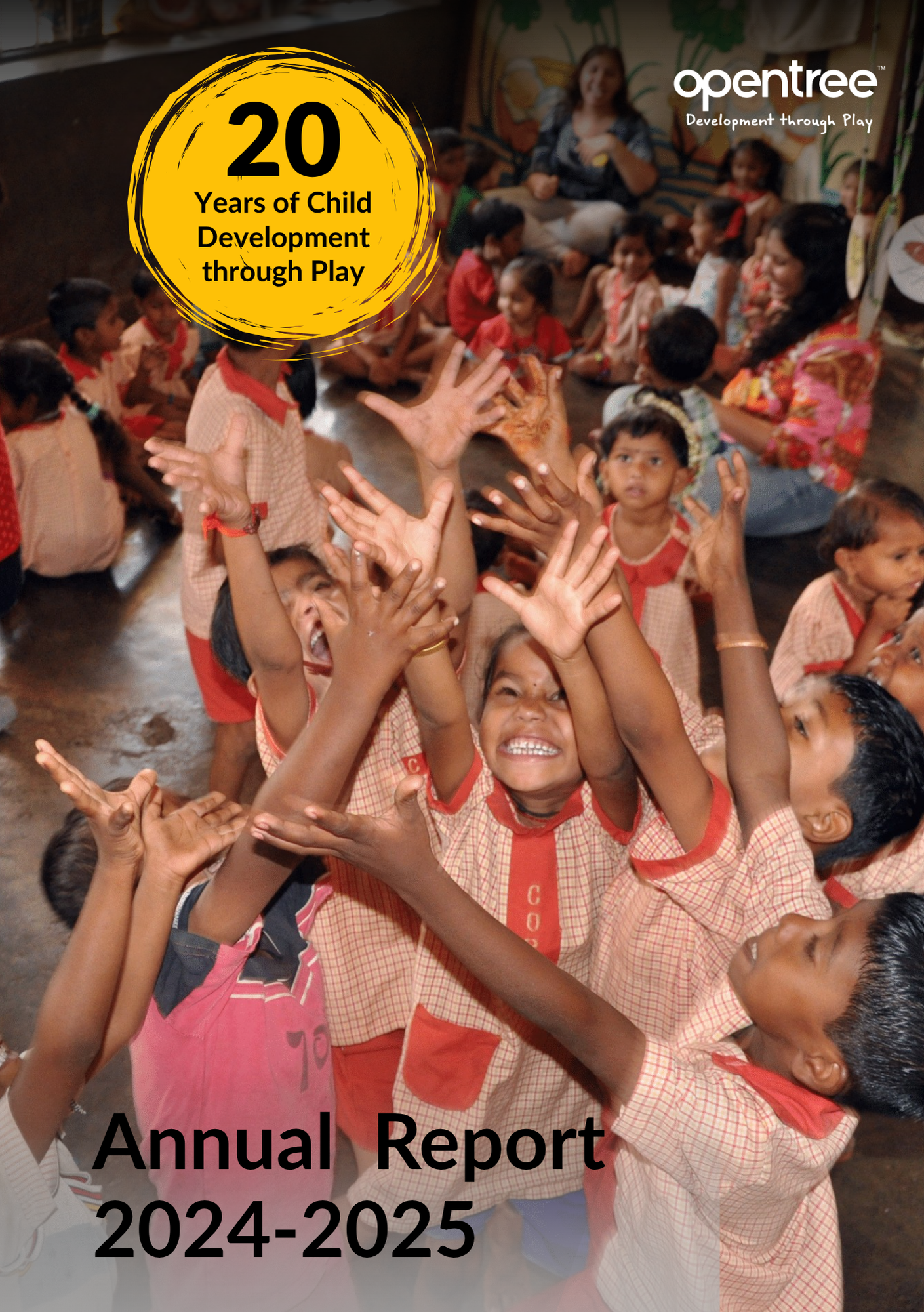
Annual Report 2024-2025: Twenty Years of Play, Joy, and Change

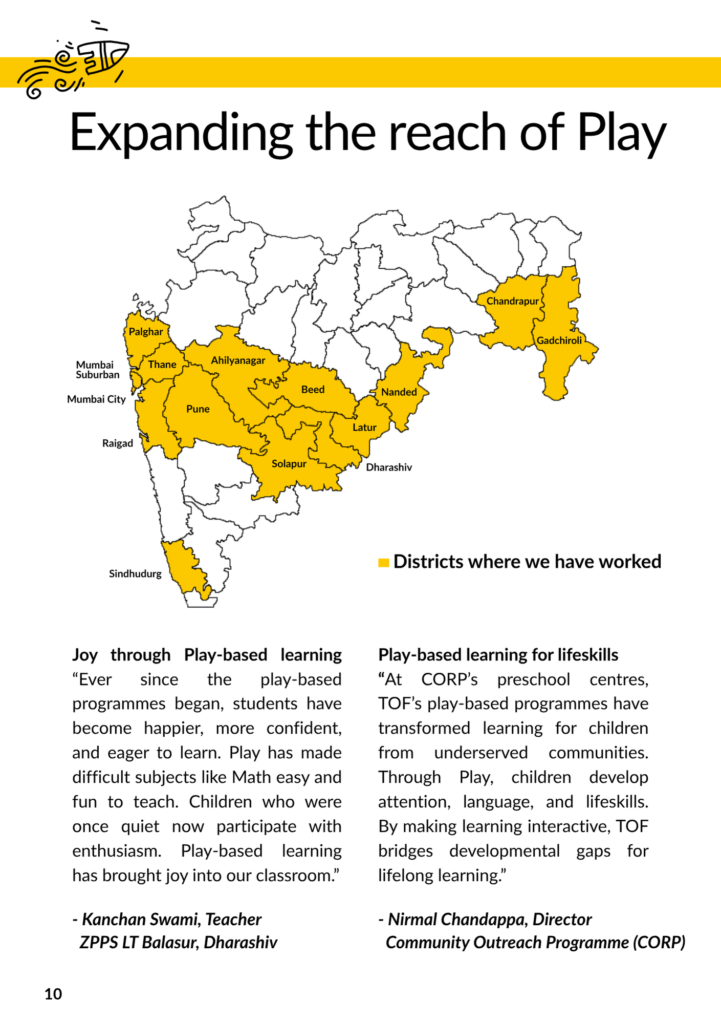
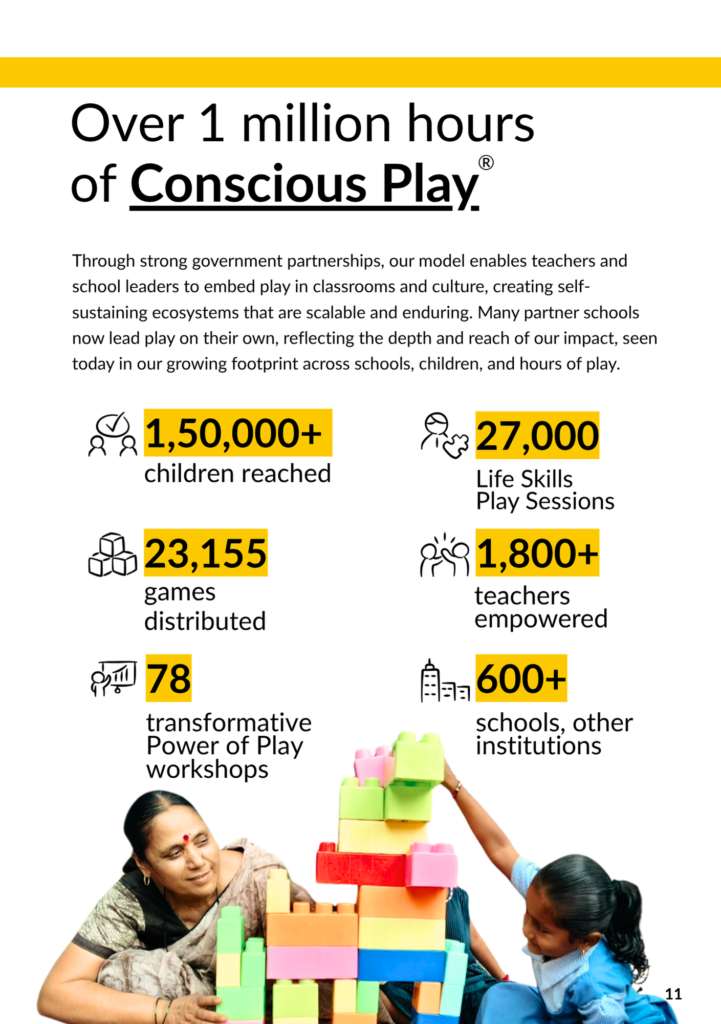
Twenty years ago, The Opentree Foundation began with a simple belief — that Play is not a luxury, but a necessity. What started in 2004 with one small group of children has grown into a movement transforming learning across 12 districts in Maharashtra. Through partnerships with 600+ under-resourced schools and 10,000+ teachers, we’ve seen how play unlocks imagination, resilience, confidence, and connection — helping children truly thrive.

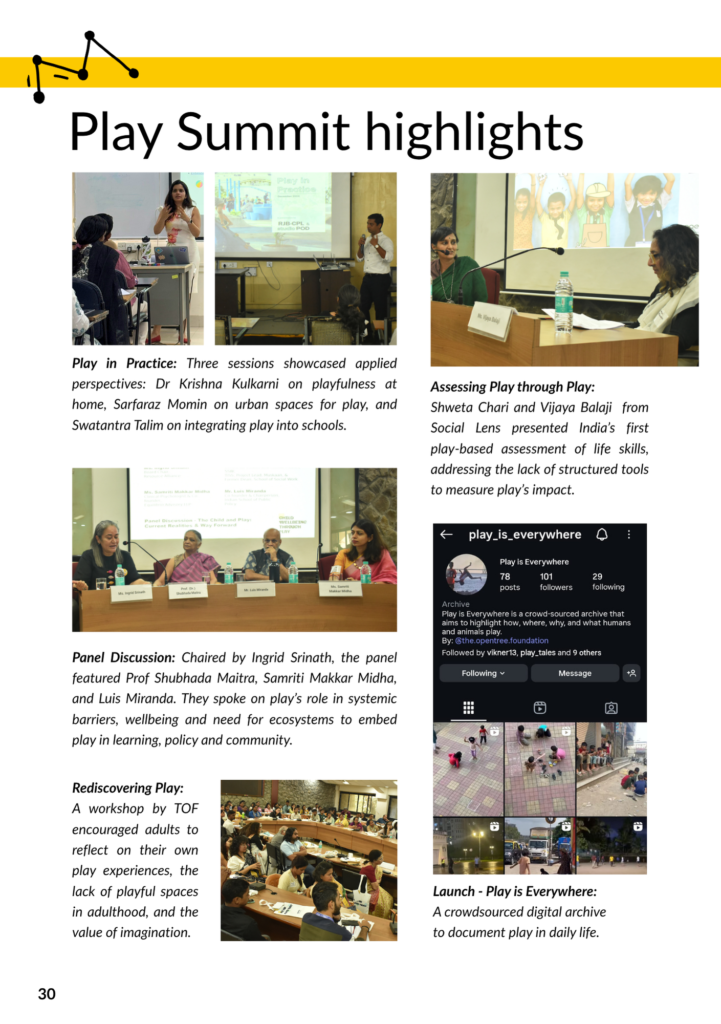
This year marked a milestone moment. We hosted India’s first Play Summit, bringing together educators, policymakers, and community leaders to champion play as central to learning and wellbeing. Our recognition by HundrED.org as a leading global education innovation reaffirmed what we’ve always known — that play has the power to change lives.

"Through our Conscious Play approach, we’ve turned classrooms into spaces of curiosity and discovery, helping every child experience the joy of learning and the confidence to explore the world."
Shweta Chari
Co-founder & CEO, The Opentree Foundation

The 2024–2025 Annual Report celebrates this 20-year journey of learning, adapting, and staying rooted in the belief that every child deserves to experience the joy and freedom of play. As we look to the future, our next bold step is clear: to reach one million children by 2030 and build systems that embed play as a right, not a privilege.

Because when we choose play, we choose a future filled with possibility and dignity. 

EVENTS

Play Summit 2025

Play Summit 2025: Finding Play

💡 Why Play Summit

The Play Summit was launched in 2024 with a single vision: to build a thriving ecosystem for Play in India.

For two decades, TOF has embedded Play into classrooms, communities, and systems serving children. Yet, Play remains missing from most policies and practices. Even globally, Article 31 — which enshrines the child's right to play — is often considered "the forgotten article of the UN Convention."

Through this summit, we aim to fill this gap and co-create a discourse on play, seeding collaborative, collective action towards mainstreaming play at both people and policy levels.

🎯 Finding Play

Playful spaces transform how people learn, connect, and participate, creating more inclusive and resilient societies. But when it disappears, curiosity, connection and creativity vanish.

Reclaiming Play has the potential to shift how we live: shaping healthier children, stronger communities, more vibrant cities and villages, and more humane systems.

Together, The Opentree Foundation and StudioPOD are convening this year's Play Summit to spark a collective reimagining: what would our schools, homes, workplaces, streets, and systems look like if play was treated as essential?

"Play is how human beings fundamentally make sense of the world. This year's theme, 'Finding Play' is our invitation to rediscover the power of play to shape kinder, more creative, and more connected communities."

Shweta Chari — Shweta Chari, Co-founder & CEO, The Opentree Foundation

🗓️ What's happening at Play Summit 2025: Finding Play

Play Summit 2025 Programme Schedule

🧠 What to Expect

🎯

Engage

Keynotes, panels, and design hackathons that inspire and inform.

🎨

Experience

Hands-on, playful installations and exhibits.

🤝

Collaborate

Meet educators, designers, policymakers, and changemakers shaping the future of Play.

👥 Who It's For

👧

Children & Young People

Leading us back to what Play feels like.

👩‍🏫

Educators & NGOs

Redesigning classrooms and programmes.

🏗️

Urban Designers & Planners

Rethinking spaces that connect communities.

🏛️

Governments & Policymakers

Embedding Play into systems.

💡

Funders & Changemakers

Investing in innovation.

🎨

Artists, Designers & Students

Prototyping new materials, ideas, and installations.

📸 Glimpses from last year: Child wellbeing through Play

Ready to Find Play?

A collaboration between The Opentree Foundation & StudioPOD

📍 Venue Location

IES College of Architecture

Opp. Lilavati Hospital, near Reclamation,

ONGC Colony, Bandra West, Mumbai, Maharashtra 400050

IMPORTANCE OF PLAYPLAY2LEARN

Like Father, Like Son: From TOF’s Inventory to Everyday Play and Learning

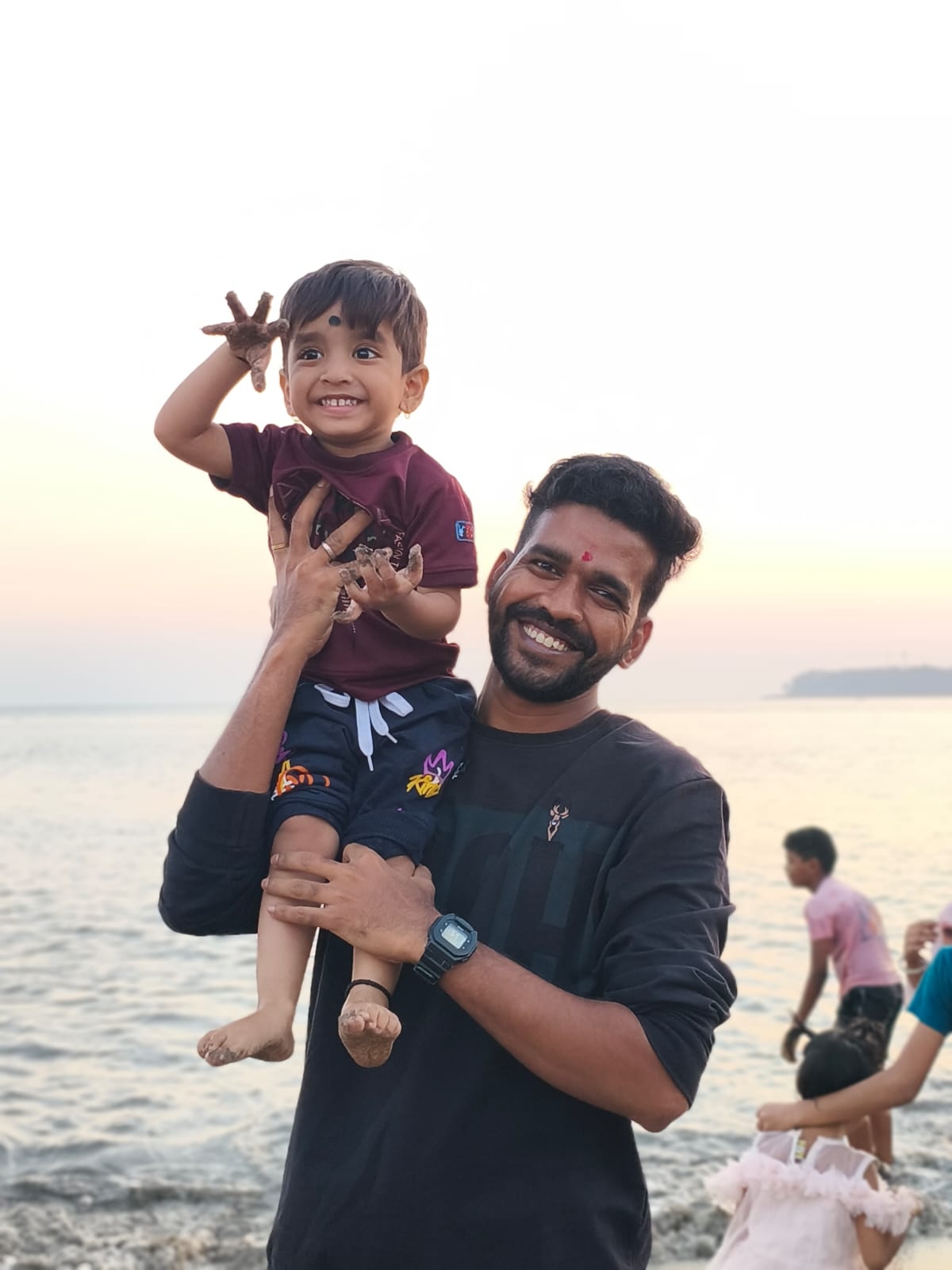
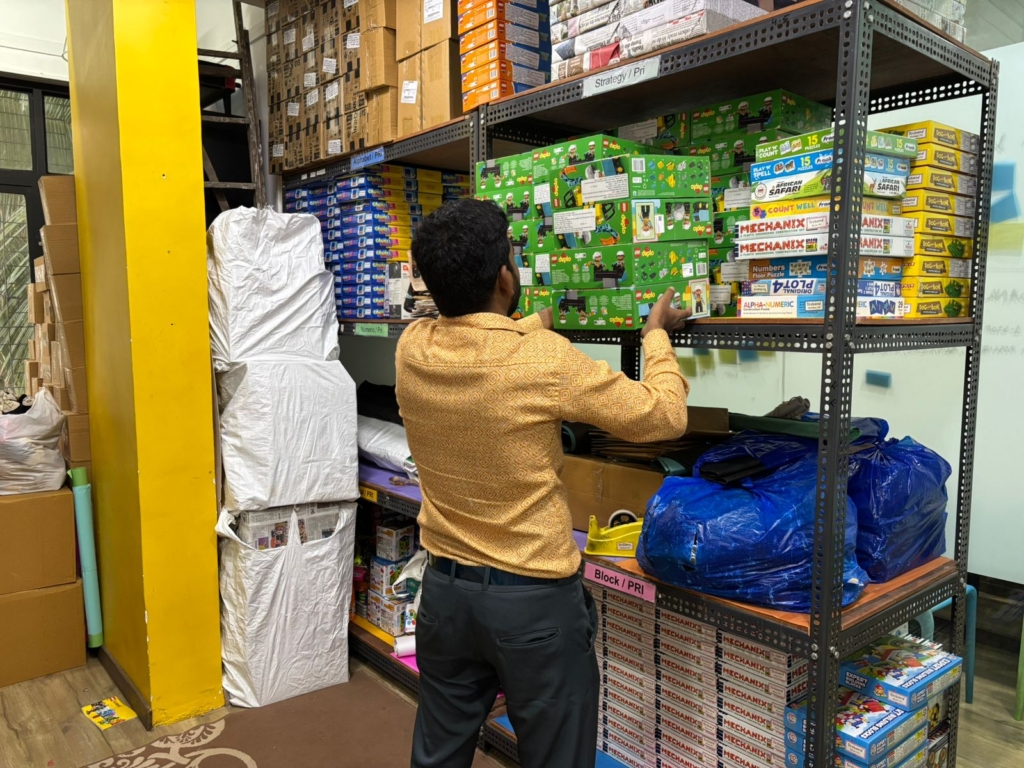
At The Opentree Foundation (TOF), play doesn’t just live in classrooms and play centres, it also finds its way into homes, into homes of its team members, shaping families and children in powerful ways. For Amol Kedase, who has been part of TOF’s inventory team since 2021, work is more than packing, dispatching, and tracking games. It is about absorbing the world of play so deeply that it naturally becomes part of his parenting. At TOF, the Inventory team looks after every aspect of the games: from sorting, coding, and packing them, to dispatching them across schools and communities. 

From Sports to Board Games

Amol has always been a lover of play. Growing up, most of his play was outdoors: running, competing, inventing games with friends. One of his fondest childhood memories is of Chalas, a self-invented game inspired by Snakes and Ladders, played with tamarind seeds. But when he joined TOF, a whole new world of board games opened up to him.

“I didn’t know board games had so much depth,” he says. “Rather, I didn’t know that play had so much depth. When I first saw the inventory room, it amazed me to see so many ways of playing and learning packed inside boxes.”

Over the years, he has become an expert in every rule, strategy, and variation of the hundreds of games TOF uses. This knowledge, he realised, could also enrich his own home and his three-year-old son. 

Play Meets Parenthood

Soon after joining TOF, Amol became a father. The timing was perfect. His professional exposure to play equipped him with new tools for raising his son, Aansh.

“The first toy I brought home was a rattler,” he recalls. “My son was barely a year old, but the sound and movement caught his attention. It helped sharpen his sensory skills.”

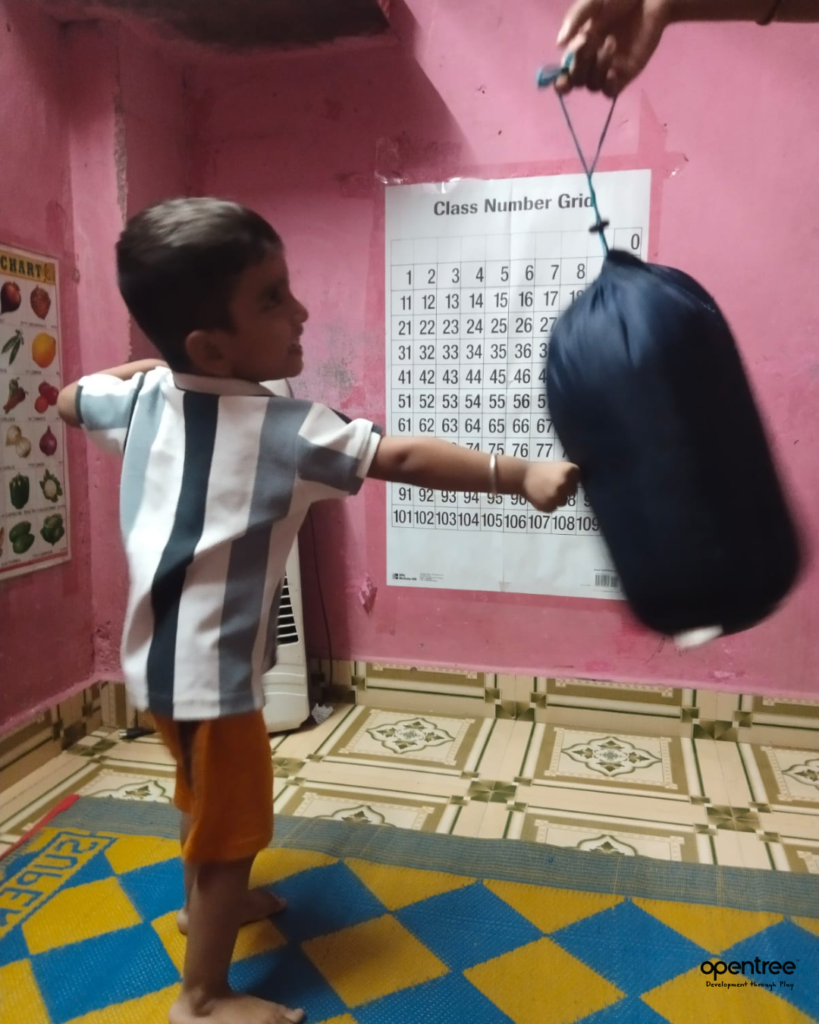
From there, Amol started introducing age-appropriate games to Aansh, sometimes directly from the TOF inventory, sometimes by improvising. At just 2.5 years old, Aansh surprised his father by reimagining a bowling game: “I had mistakenly lined up all six bottles in a straight row, so they wouldn’t fall properly. Aansh suggested placing them in rows of two. He kept changing the formation to make the game more fun. That was the first time I realised how play could build problem-solving skills at such a young age.”

Play helps Aansh lead, learn, grow

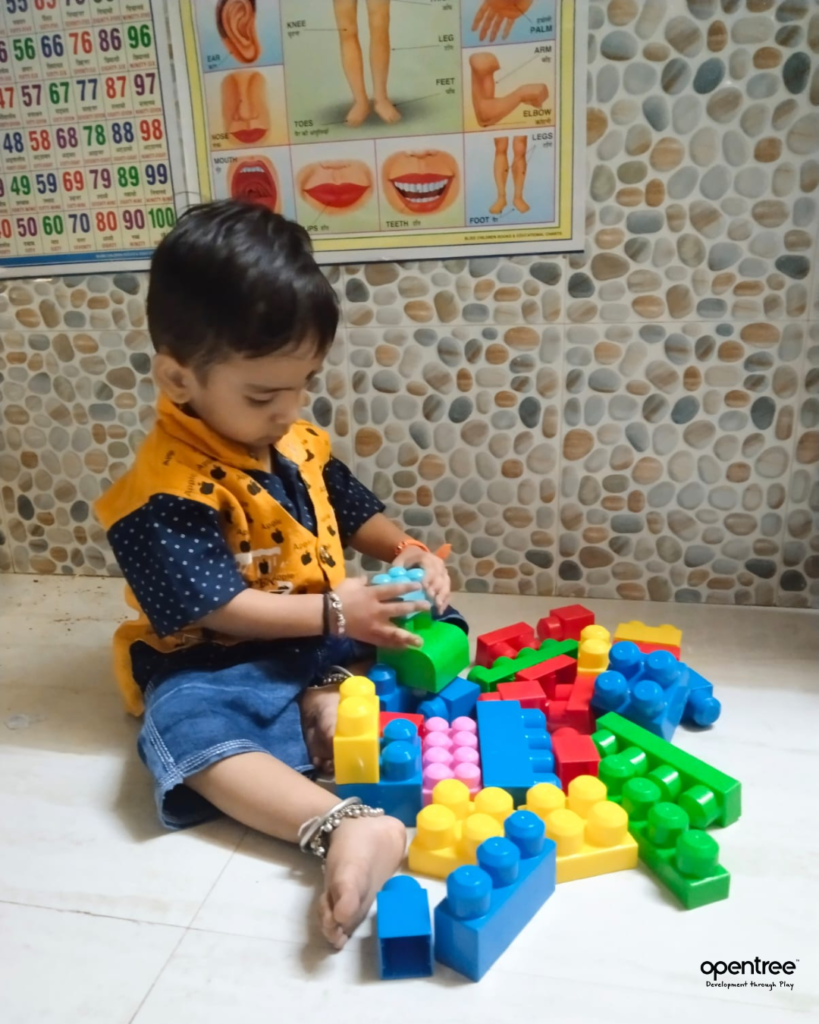
For Aansh, play is more than fun, it’s a way of learning about the world. He quickly picked up numbers, alphabets, and shapes through puzzles and sorting games. With a map puzzle, he began recognising states and capitals. He even memorised the names of social leaders like Dr BR Ambedkar, proudly identifying them from photos his father pinned up at home.

But beyond academics, Amol noticed deeper social and emotional growth. “He plays the role of a teacher with younger children in our neighbourhood,” Amol shares. “He talks politely, helps them when they get stuck, and even teaches them to say thank you.”

In moments of frustration too, play taught resilience. “Sometimes he gets bored or upset with a game. Instead of forcing him, I change the rules to make it interesting again. Play gives children agency, and it’s important to let them own that.”

A Child Who Waits for Games Every Day

For Aansh, games are now a part of daily life. The moment Amol steps home, his son’s first question is: “What game have you brought today?” Whether it’s a brand-new puzzle, blocks, or even preloved donated books and toys, the excitement is the same.

Interestingly, his creativity isn’t limited to ready-made games. Building things is his favourite way to play. Soap bars and biscuit packets at home often turn into blocks for towers and bridges. “He once made a three-storey building out of soap,” Amol laughs. 

Lessons Beyond the Inventory

Amol believes that play has given his son a faster grasp of concepts compared to traditional teaching methods. “In school, when other parents asked why my younger son was admitted early, the teacher explained that he was already comfortable with rules, packing away games, and answering questions, skills children usually learn much later. That was all thanks to the exposure he got through play at home.”

For Amol, this blend of work and fatherhood has created a unique bond. Whether it’s fishing out toy fishes faster than the rest of the family, or confidently narrating the rules of a new game, every shared moment strengthens their connection.

When Play Becomes a Way of Life

Today, Amol sees play not just as an activity, but as a foundation for any child, something that keeps children curious, teaches resilience, and strengthens family bonds. “Children mirror us,” he reflects. “Even on tired days, I make time for play because I know it shapes how my son grows up. Play has truly become a way of life in our home.”

At TOF, stories like Amol’s remind us that play is not just for the children we work with, it transforms our team members and their families too. When play comes home, learning never stops.

EVENTSIMPORTANCE OF PLAYPLAY2LEARNSAFE SPACE

Building Childhoods Through Play: Celebrating 21 Years Together

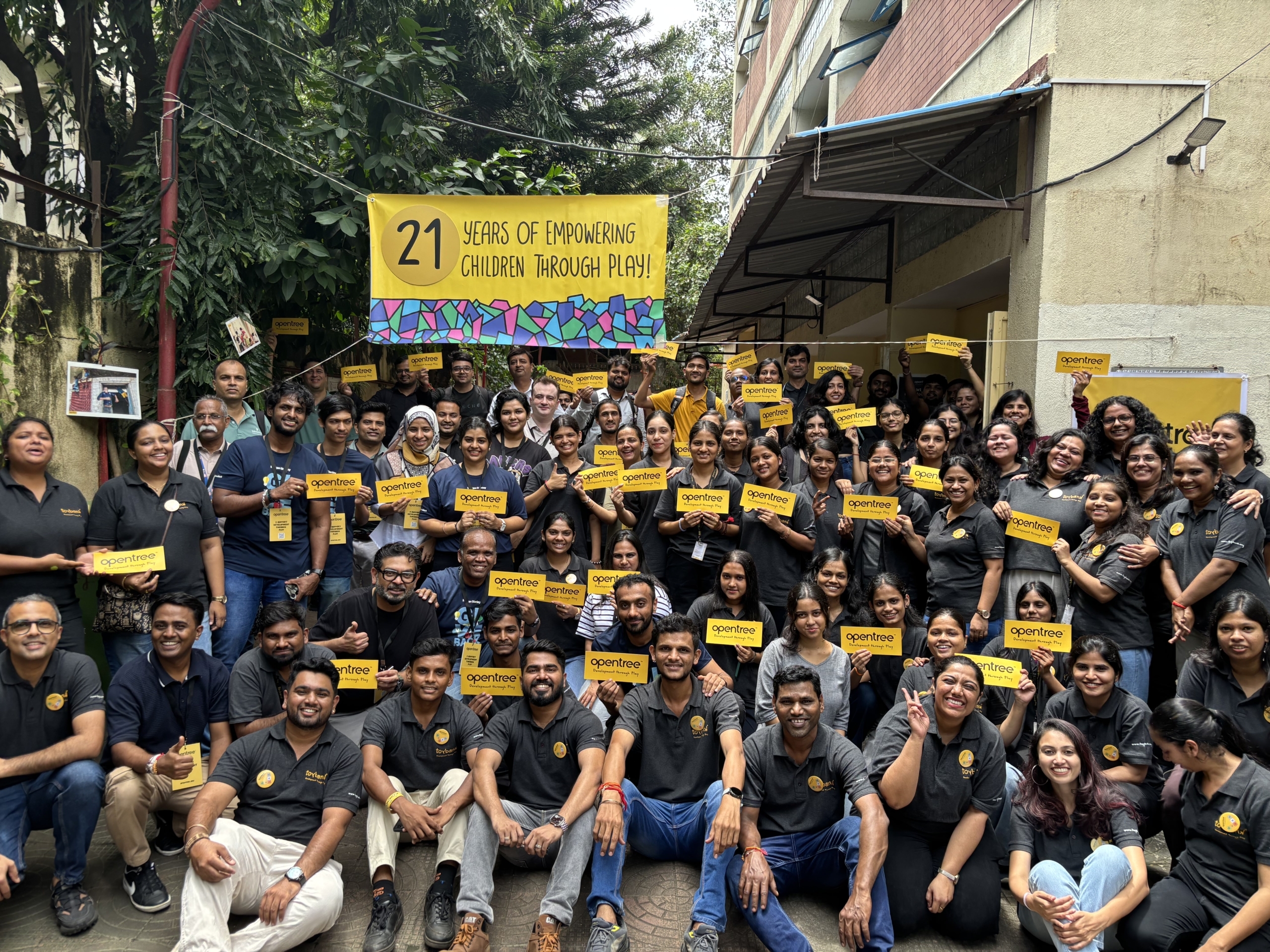
On August 23, 2025, The Opentree Foundation’s flagship project, Toybank, celebrated its 21st Foundation Day, at SS Sahney School, Khar, marking over two decades of championing play as an essential part of every child’s life. The milestone was celebrated in the most fitting way possible: by bringing the joy of games, stories, and creativity to more than 1,000 children, with the support of our incredible volunteers.

This year’s celebration was not just about distributing games, but about immersing our volunteers in the true essence of our mission: using play and play-based learning to build life skills that prepare children for life.

A Day of Play, Learning, and Fun

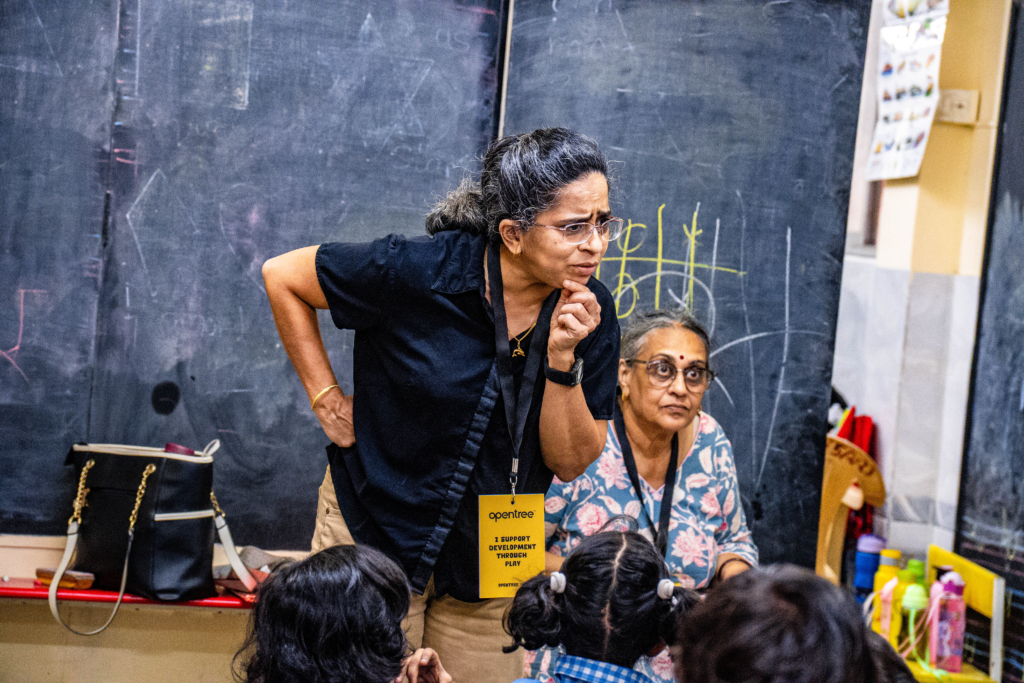
The day began with a special pep-up session for all volunteers. This wasn’t just an orientation, but an opportunity for them to experience what our play sessions with children feel like. Through interactive activities, volunteers got a glimpse into the power of play and why it is not just about fun, but about creating safe, nurturing spaces where children can express themselves freely.

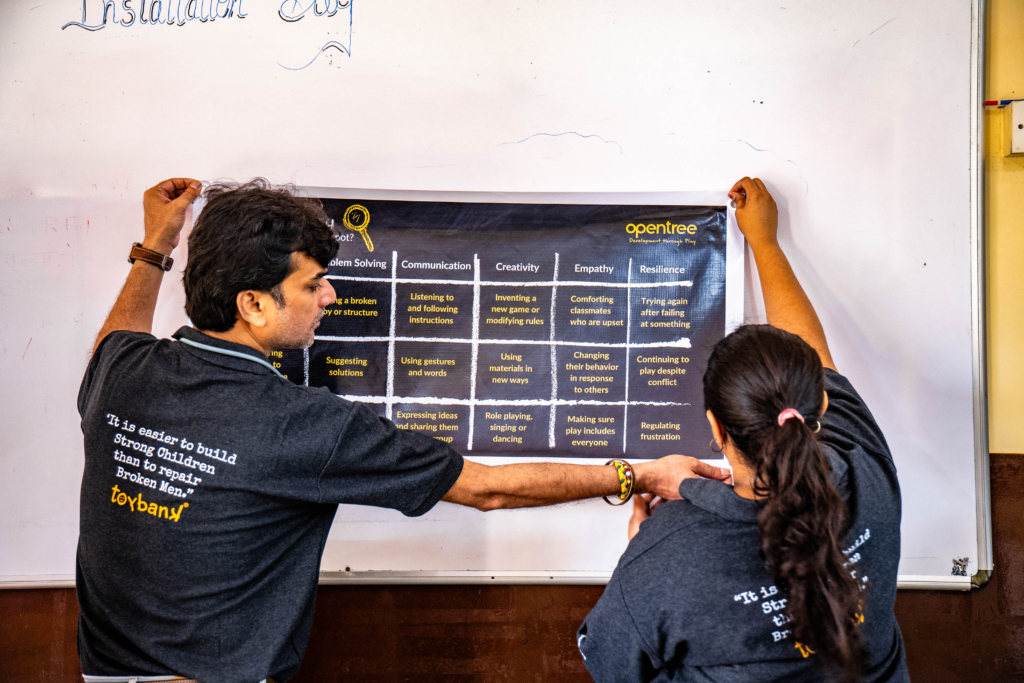
After this, the volunteers were divided into groups and sent into classrooms to assist our play workers in play sessions. These sessions are part of our Life Skills Play Programme, which carefully curates games based on the age, interests, and competence levels of children. Each game is thoughtfully selected to strengthen skills such as communication, problem-solving, resilience, empathy, and teamwork. What may appear as a simple board game or group activity to an outsider, is in fact a tool for building critical life skills that shape confident, empathetic, and curious learners.

Storytelling and Origami: Play in Many Forms

Play takes many forms, and the Foundation Day celebrated this diversity beautifully. In one class, our long-time volunteers Nutan and Jyoti conducted a storytelling session for Senior KG students.

For the children, it was an hour of imagination and wonder, but for us, it was also a reminder of how stories spark creativity, build language, and nurture empathy. Jyoti, who has been a steadfast volunteer with us for years, exemplifies what it means to be a play champion, someone who understands that play is serious, transformative work.

In another classroom, Ranjana and her daughter Sailee, both regular volunteers at our Foundation Days, conducted an engaging origami session with Class 4 students.

Beyond the joy of folding paper into animals and shapes, origami helps children develop patience, focus, and fine motor skills. Volunteers like Ranjana and Sailee remind us how play is not bound by age, and how generations can come together to celebrate creativity.

Interactive Spaces of Reflection

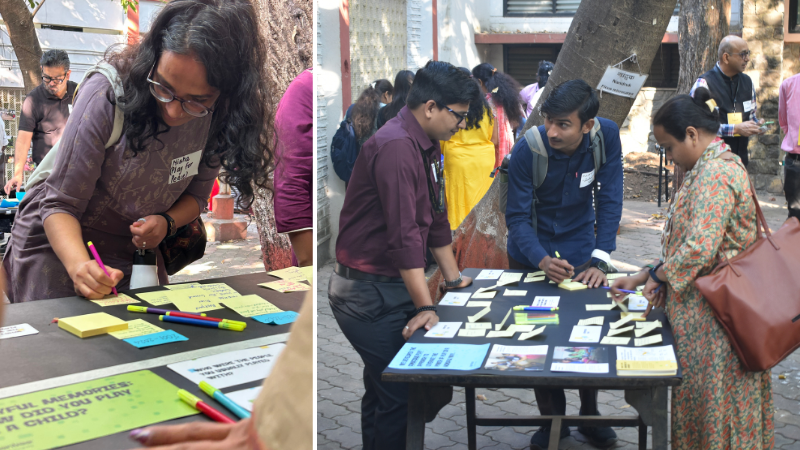
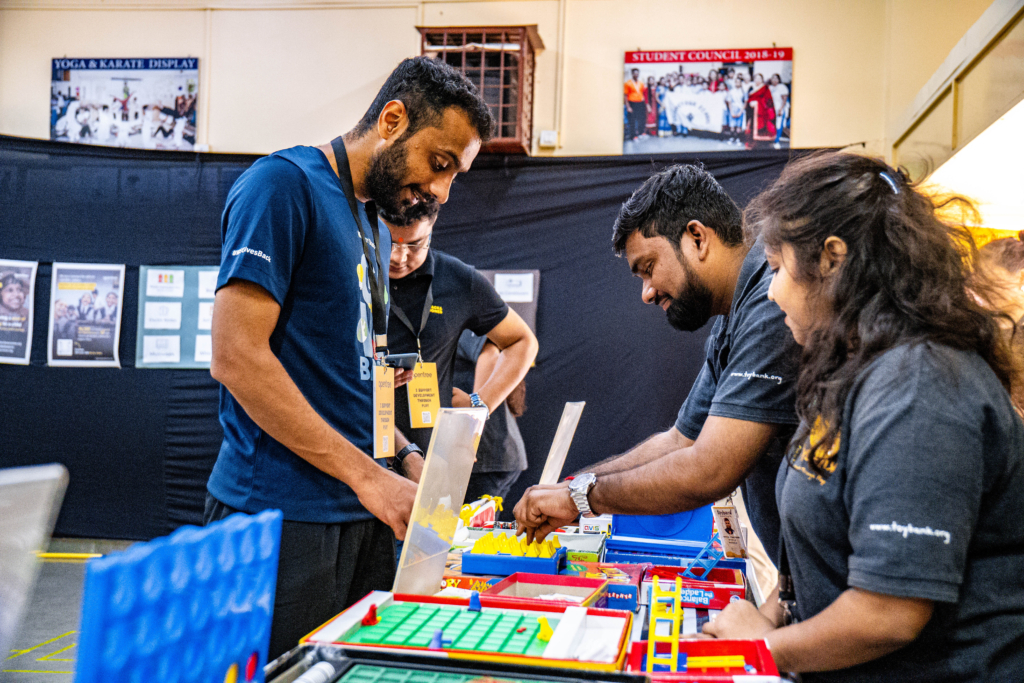
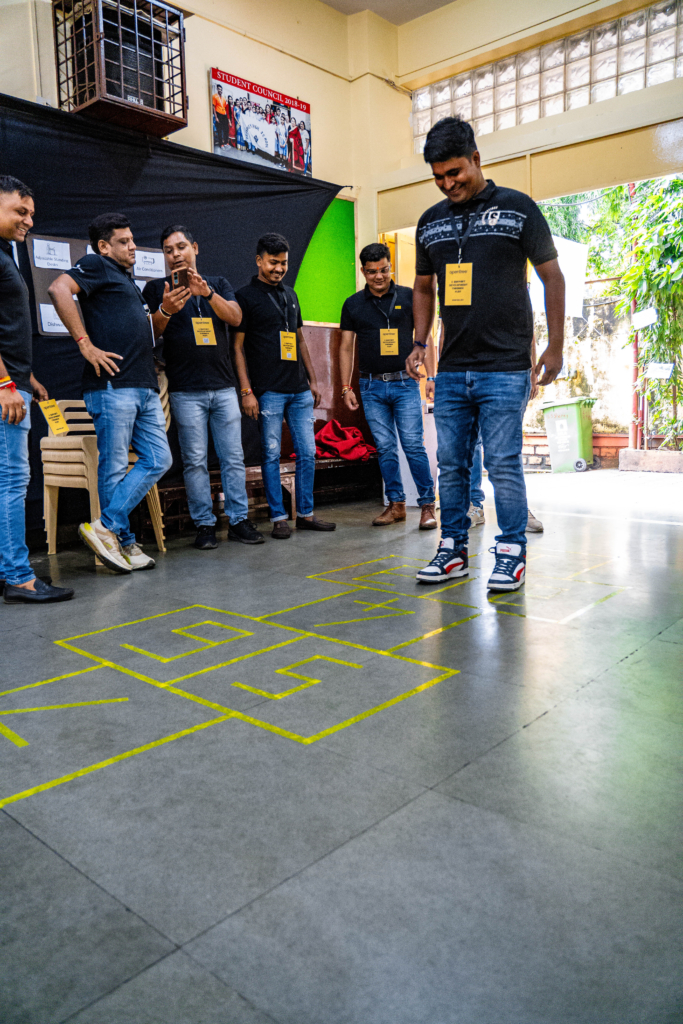
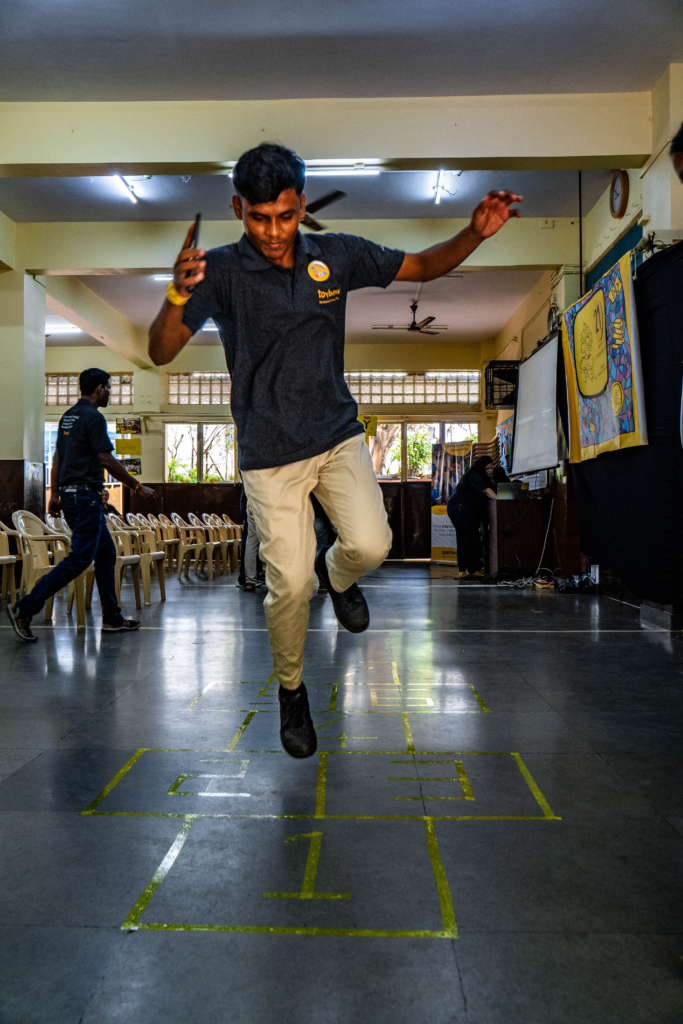
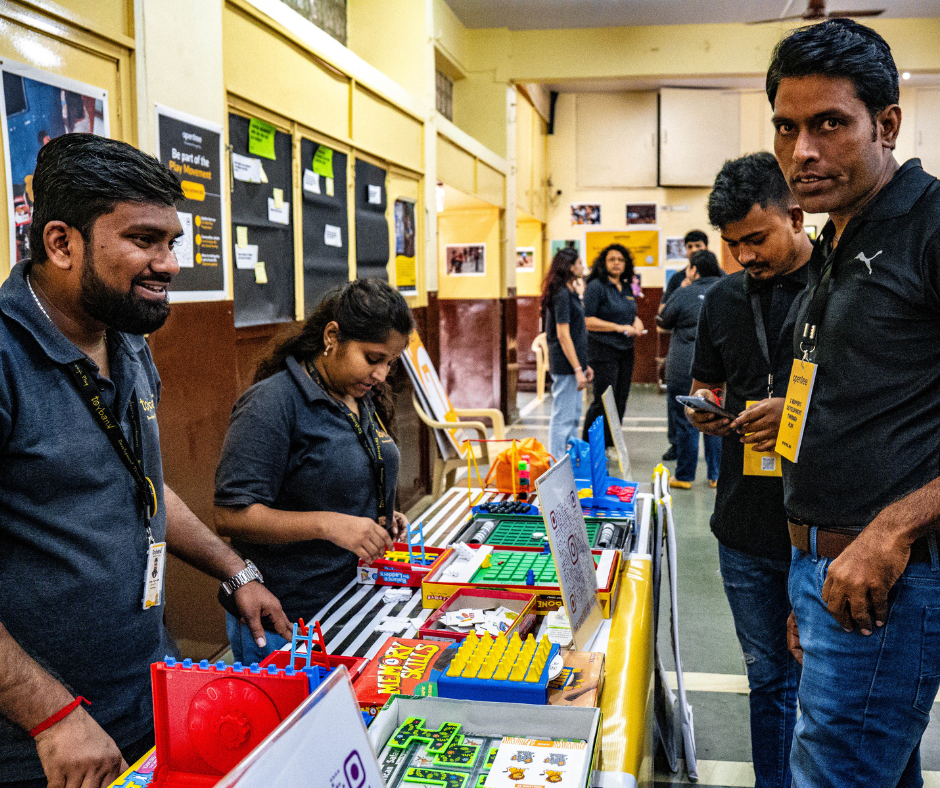
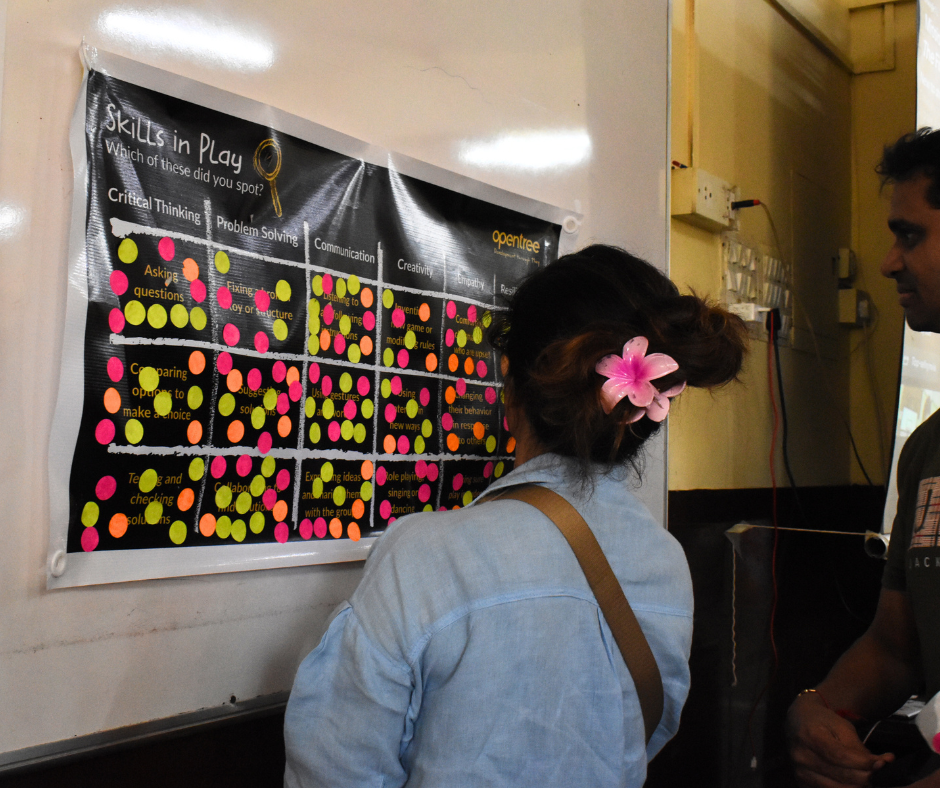
The celebration wasn’t limited to the classrooms. The hall was alive with interactive activities designed to make volunteers reflect on the skills that play builds. A specially created Play Bingo wall encouraged participants to spot and mark the different life skills they witnessed during the sessions. Another corner featured a hopscotch grid, inviting adults to travel back to their own childhood and rediscover the pure, unstructured joy of play.

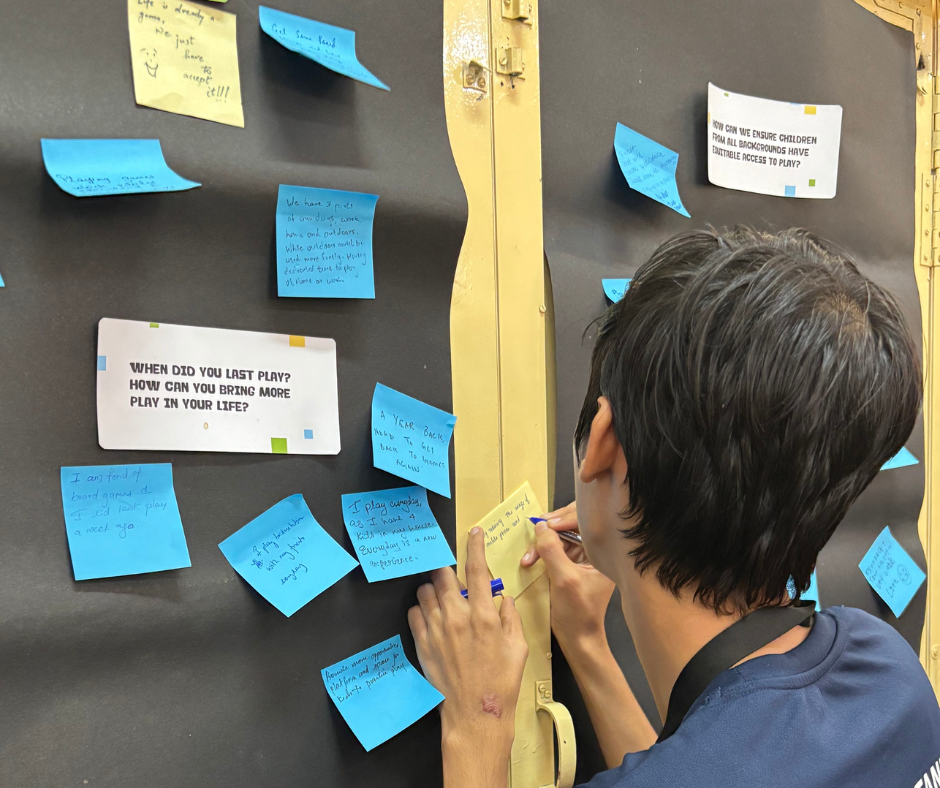
We also had a wall where participants could share their favourite childhood memory or a game they loved most as children. Reading through these notes reminded everyone of a simple truth: play is universal, timeless, and essential. At our kiosk, we displayed the very games we use in our Life Skills Play Programme, allowing volunteers to explore how each game connects to specific skills children need to thrive.

Voices of Play

One of the highlights of the day was hearing from our volunteers themselves. Many spoke about how their understanding of play had shifted through their time with The Opentree Foundation. “I never saw play from this perspective,” shared one volunteer. “I always saw it as an afterthought. I didn’t know that play helps build these life skills and volunteering today with TOF allowed me to see that.” 

These reflections capture exactly why TOF exists: to change the way the world sees play, from something ‘extra’ to something fundamental.

Our founder, Shweta Chari, summed it up perfectly: “We use play and play-based learning to transform classrooms into safe spaces for children to express themselves and be themselves, to build the teacher-student bond, to get children to be curious, to ask more questions, and to be uninhibited. Play transforms childhoods.”

We were honoured to have esteemed guests including Rizwana Shaikh, Principal of SS Sahney School, Khar, and Dr. Sanjay Chavan, Principal of Rajawadi School, among others. Their presence and encouragement highlight the importance of embedding play in education systems and policies.

But above all, this day belonged to our volunteers, our true play champions. From leading activities in classrooms to sharing their own stories of why they support play, their energy and commitment made this milestone celebration possible.

IMPORTANCE OF PLAYPLAY2LEARN

From Conversations to Connection: Fueling Our Playful Vision

At The Opentree Foundation (TOF), we’ve always believed that the work of building happier, healthier childhoods cannot be done alone. It takes deep partnerships, collective vision, and people who believe, not just from afar, but who show up, sit beside us, and walk the journey with us. One such person is David Millary.

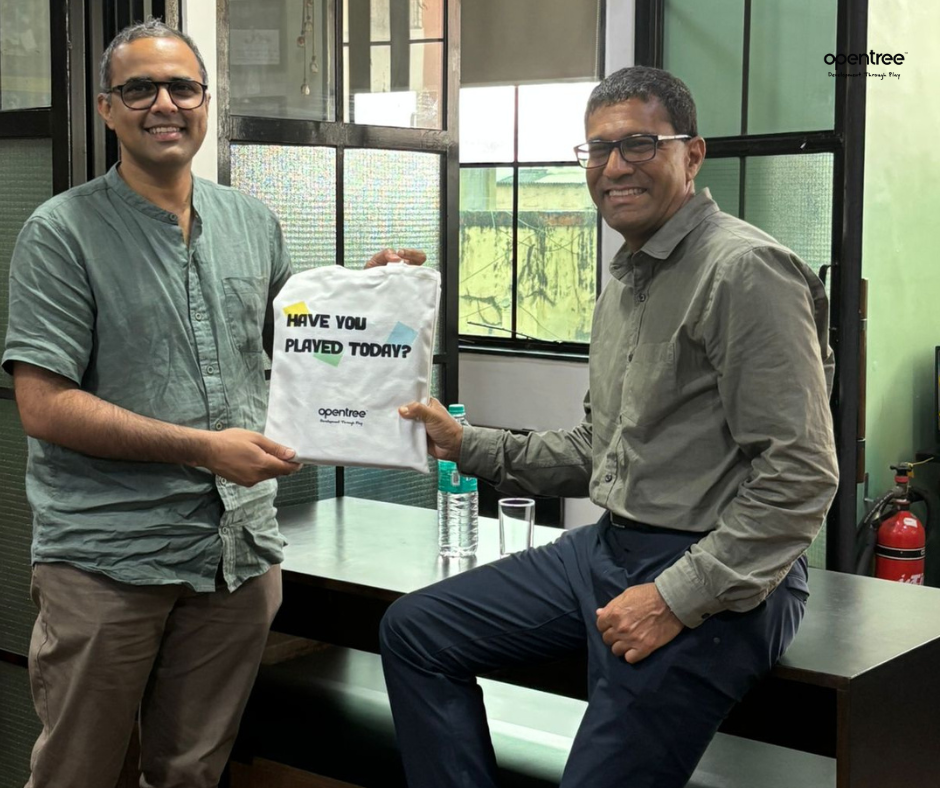
David has been a long-time friend and supporter of TOF for over six years. Earlier this month, he made a special three-day visit to India with a focused goal: to co-work with our team and help us plan more effectively, as we scale our work to reach 1 million children with play by 2030.

From day one, David’s energy was rooted in genuine connection. At our office in Mumbai, he spent time co-working with the team, not just advising, but actively engaging with the realities, ideas, and systems behind our work. He spoke to the larger team about why play matters and why what TOF does is critical. “Children never start from zero,” he shared. “Every child has a spark in them. Children TOF is working with, every one of them has something unique to offer the world.”

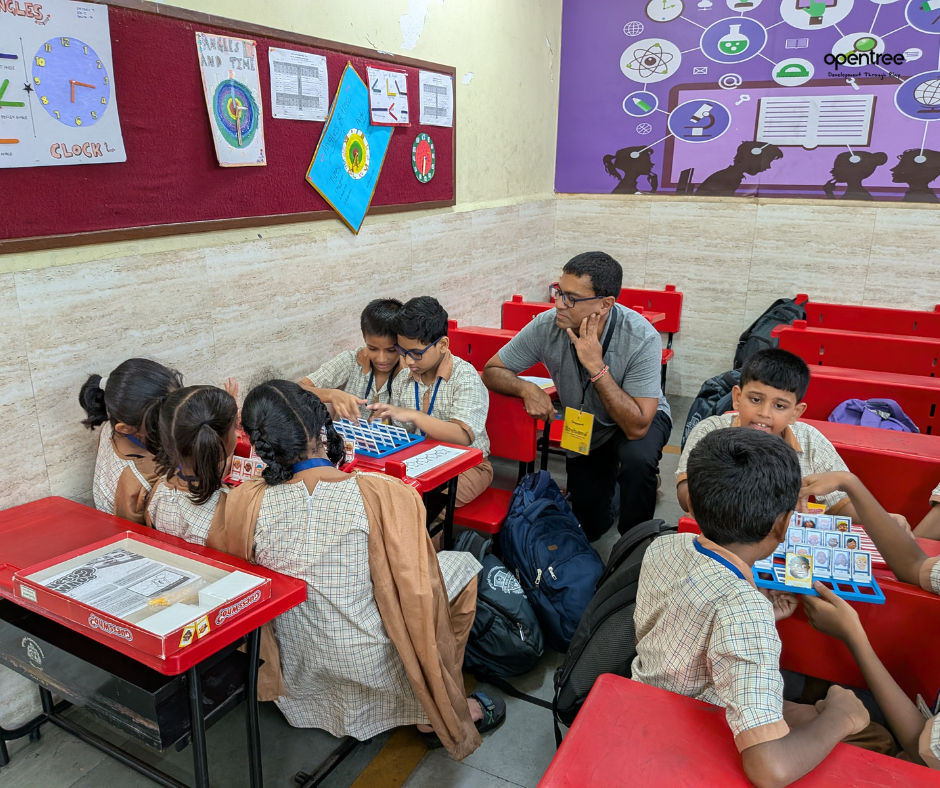
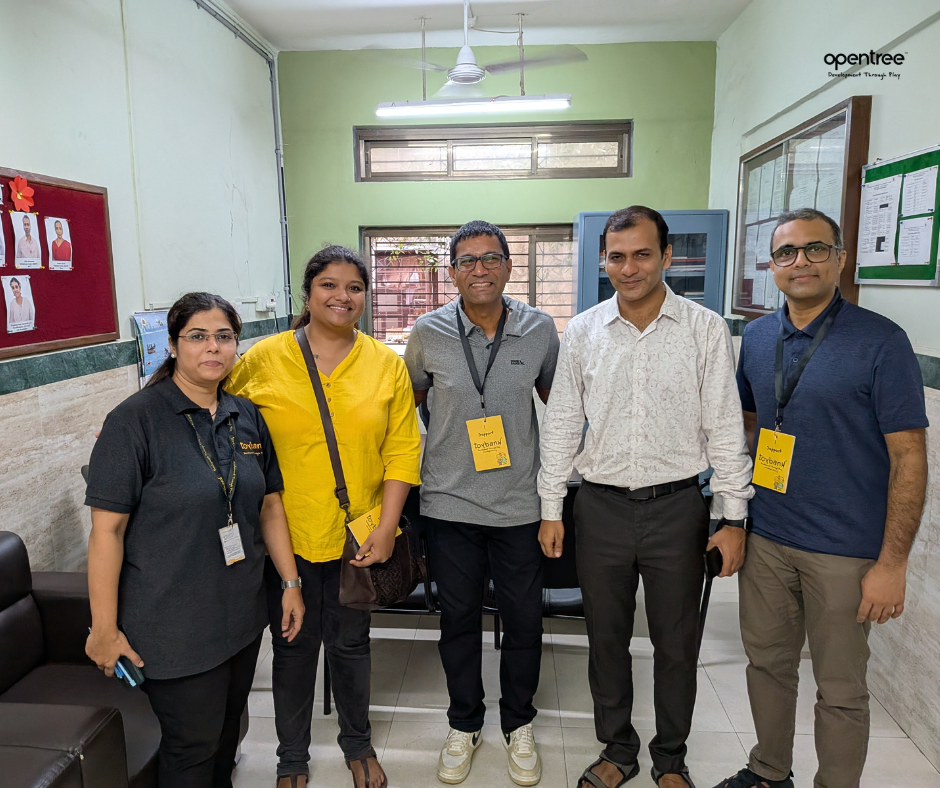
David also visited a play session at the Mumbai Public School, where Class 5 students were playing games that help build skills of communication and critical thinking. He joined the children in a round of Guess Who, admiring the strategies they used and the joy with which they played. He later spoke with the class teacher, who shared how useful TOF’s play sessions are, especially on busier days. The school’s principal echoed her thoughts, saying that in the past three years of partnering with TOF, the presence of play has built visible camaraderie and teamwork among the students, even when TOF facilitators aren’t around.

The visit culminated in our TOF Circle: Vision and Connection evening, an intimate gathering of our long-time supporters. Together, we reflected on our journey so far and discussed where we hope to take the power of play in the years ahead. David’s voice in the room grounded us, reminding everyone of the human connections behind the mission.

We are deeply grateful to David for taking the time to visit us, for working alongside us, listening to us, and cheering us on. In a world where many causes compete for attention, it means so much when someone chooses to stand with you, not just in words, but in presence.

David’s visit was a moment of reflection, motivation, and alignment. It reminded us that we are not alone in this mission to make play a right, not a privilege. And for that, we are truly thankful.

IMPORTANCE OF PLAYPLAY2LEARN

IDOP 2025: Choosing Play, Every Day to Reclaim Childhood

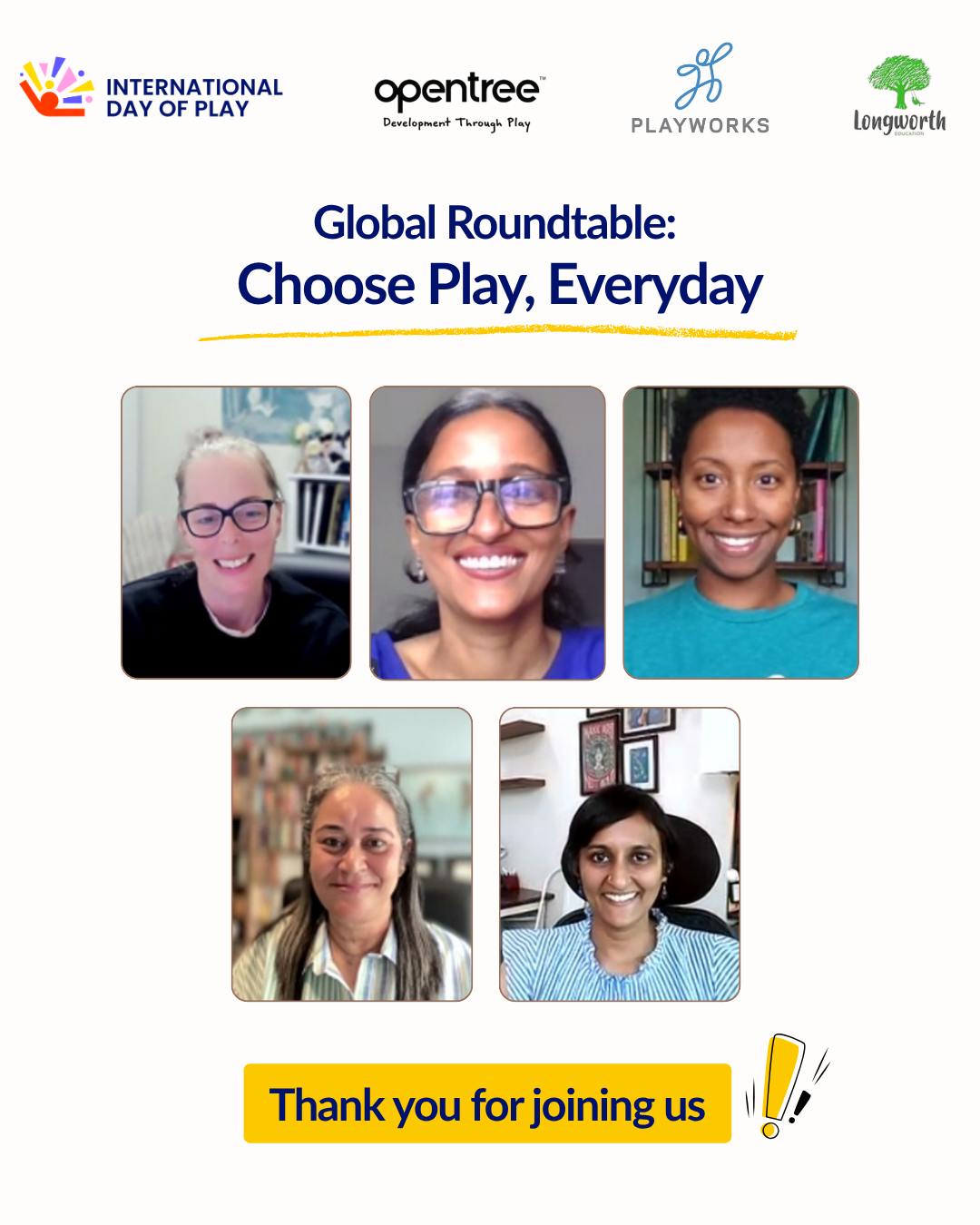
This International Day of Play, The Opentree Foundation hosted a powerful roundtable discussion titled ‘Choose Play, Everyday’, bringing together global voices to tackle a quiet crisis: the disappearance of play from children’s lives.

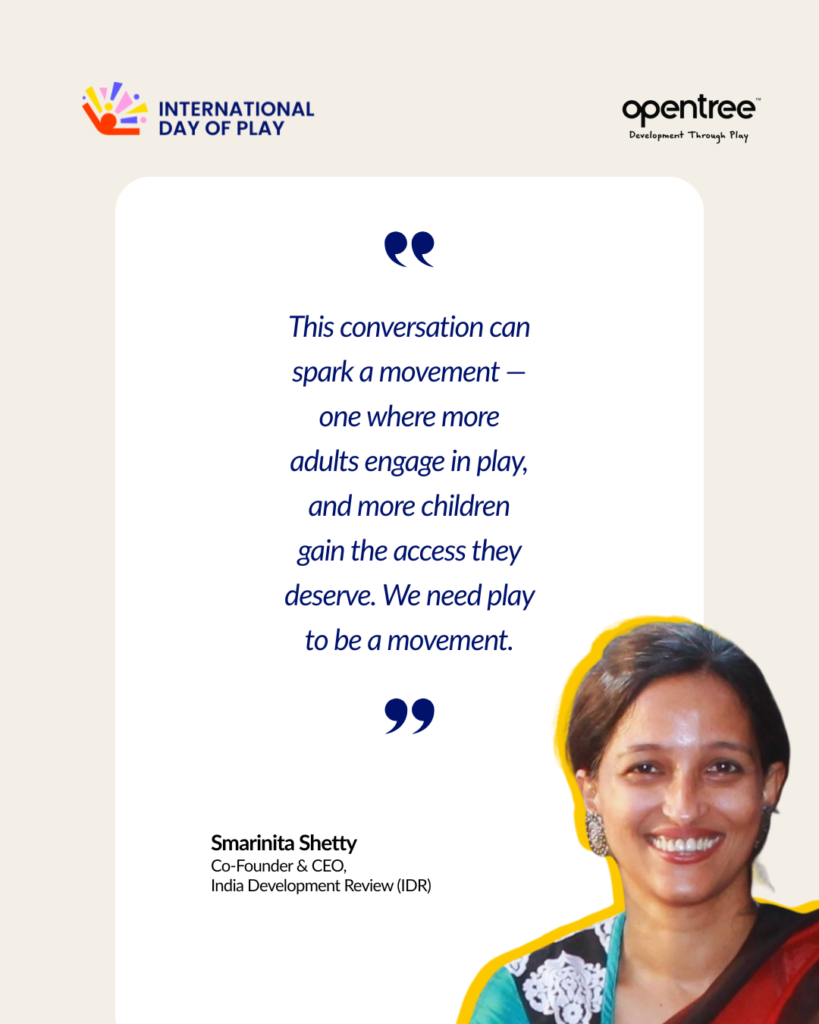
Moderated by Smarinita Shetty (India Development Review), the panel featured Dr Sarah Aiono (Longworth Education), Tia Mathisen (Playworks), Ingrid Srinath (Resource Alliance), and our very own Shweta Chari (The Opentree Foundation). The session explored how play, a natural right of every child, has been sidelined in classrooms, homes, and policy conversations.

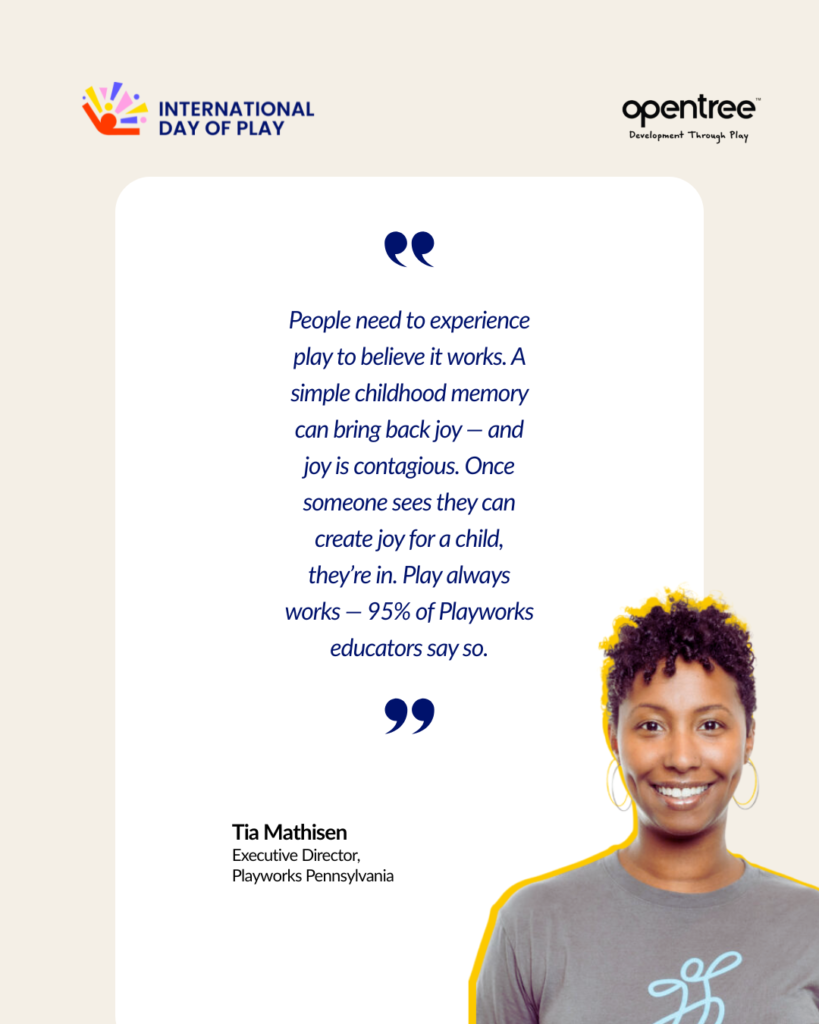
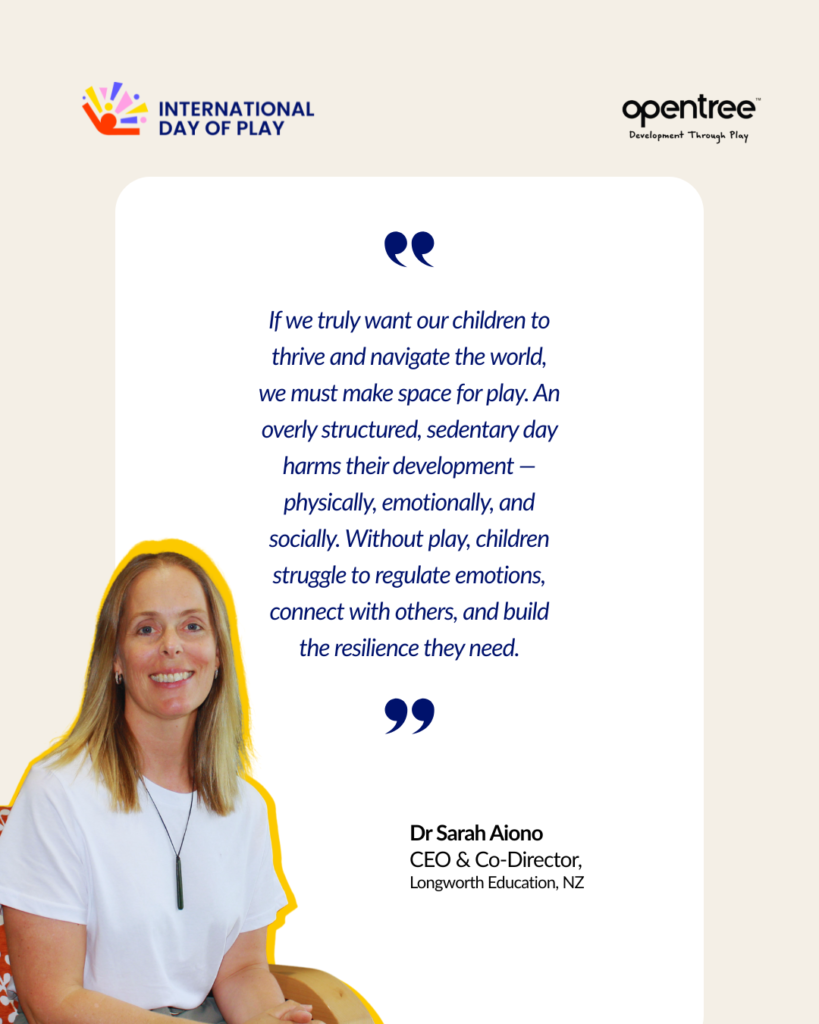
Panelists emphasised that play is not a luxury but a foundational element of childhood. Dr Aiono shared insights on how educators can bridge the gap between knowledge and practice, ensuring play is not reduced to a token activity, but embedded meaningfully in curricula. Tia Mathisen spoke about the power of adults rediscovering play for themselves, creating joyful moments that lead to lasting mindset shifts.
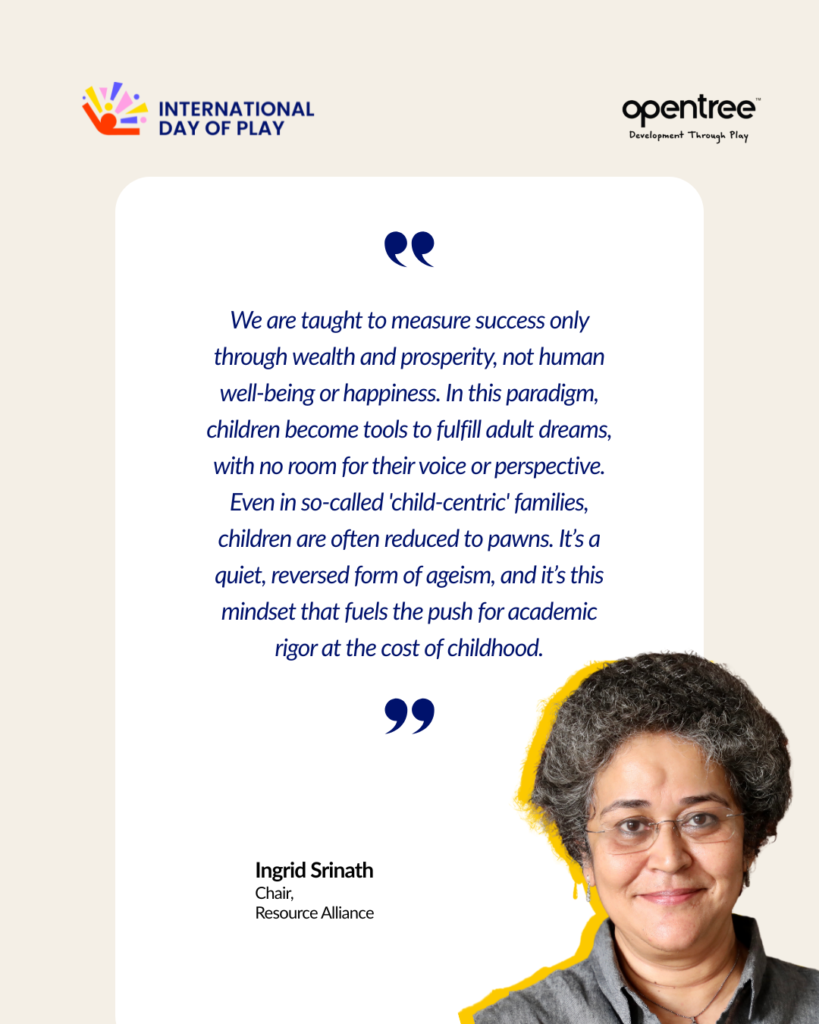
Ingrid Srinath reminded us that systemic change won’t happen until we redefine success, moving beyond grades to include creativity, wellbeing, and joy. And Shweta Chari brought the message home: “It’s so obvious. But still not understood.”

The way forward is clear: we need more data, yes, but we also need more demonstration. We need to let funders, policymakers, and educators feel the power of play. 

At The Opentree Foundation, we remain rooted in our belief: it’s easier to build strong children than to repair broken adults. And in a world that desperately needs healing, choosing play every day might just be the most radical, hopeful act of all.

IMPORTANCE OF PLAYPLAY2LEARN

Playful Learning: Class 8 Students Discover Power of Play Through Game Design

Class 8 students of Govind Nagar English School in Malad recently wrapped up their academic year with a playful but powerful experience that demonstrated how deeply play supports learning and skill-building, and what the students had learned through play sessions. 

The previous play sessions have exposed them to different kinds of games and got them thinking about the different aspects of problem-solving such as asking questions to find information about a problem, brainstorming solutions for a problem, how do you pick the correct idea and so on. 

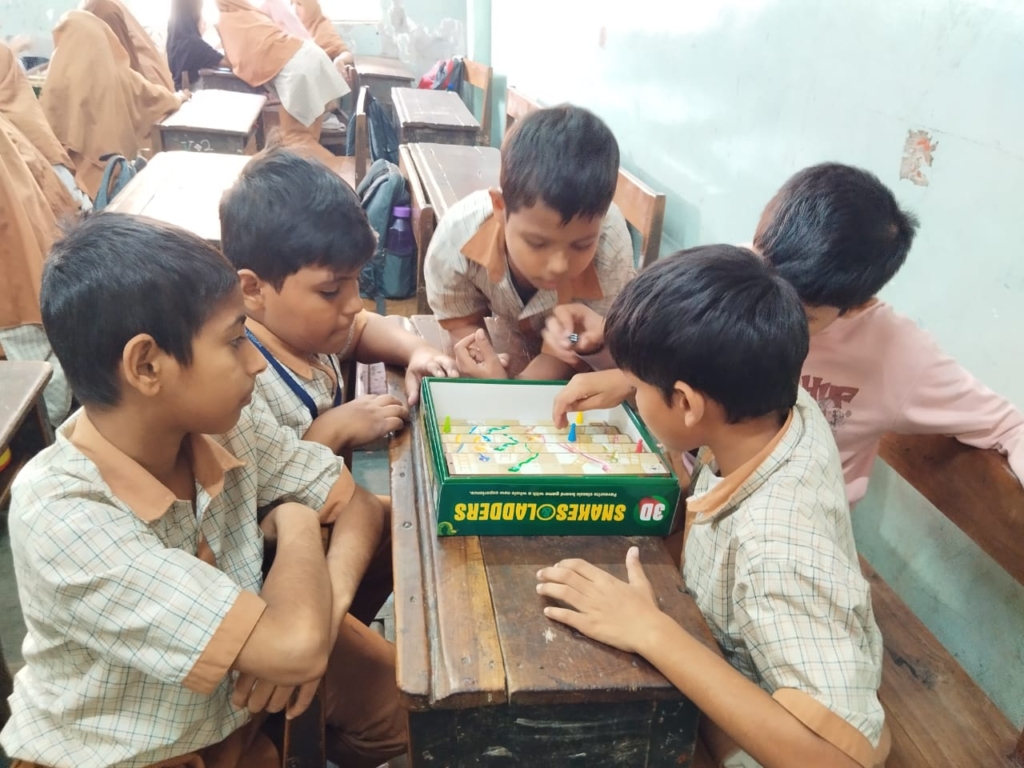
In this session, we asked students to think about the structure and design of a game. There was a detailed discussion with students about what goes into making the game and how games are designed. Then, there was a conversation about what goes into a game’s mechanics: what are the rules, how does the game progress forward, are there any intentional challenges that are created. For example: in snakes and ladders, you have a snake right before the last block, which makes it difficult for the player to win immediately. We had a conversation with students about how these factors together make a game interesting and then we asked them to develop their own games. 

At first, the task felt daunting. A certain group of students were not sure where to begin or how to even structure a game. This is where our Outreach Play Worker (OPW) stepped in and asked them to begin with brainstorming. This encouraged the students to tap into one of the most important skills that play nurtures — creative thinking. As they shared ideas and built on one another’s suggestions, their confidence grew. They decided to design a quiz-based board game with general knowledge as the theme. 

The process of creating their own game allowed students to practice collaboration, problem-solving, and communication. They worked together to design a colorful board, draft thoughtful questions, and list down clear rules. Their game was called Mind Masters: General Knowledge.  

Following this, the students engaged in feedback, another essential life skill. Members from different groups played their game and provided constructive feedback. The teams analysed it and discussed what could improve, especially in terms of design and rules. They realised their game could be more engaging if they expanded it, so they decided to include questions about different capitals of countries and not just limit it to India, to make the game more challenging.

This iterative process of building, testing, receiving feedback, and refining their ideas helped the students broaden their thinking. They were more open to try something new or adjust their ideas based on group discussions. Each team member brought a unique perspective, and through this collaboration, they strengthened not just their game, but also their interpersonal skills.

Their journey shows that when children are given the space to explore, create, and collaborate through play, they naturally develop critical skills like creativity, adaptability, teamwork, and problem-solving.

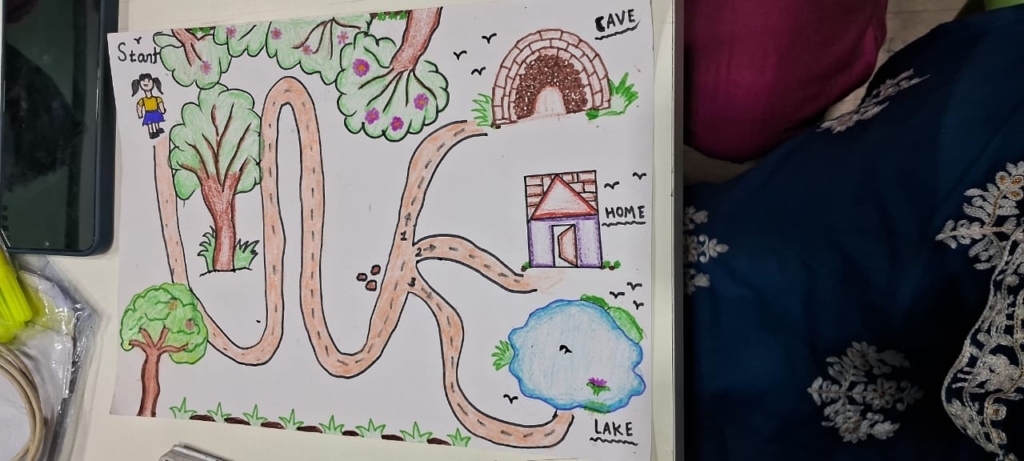
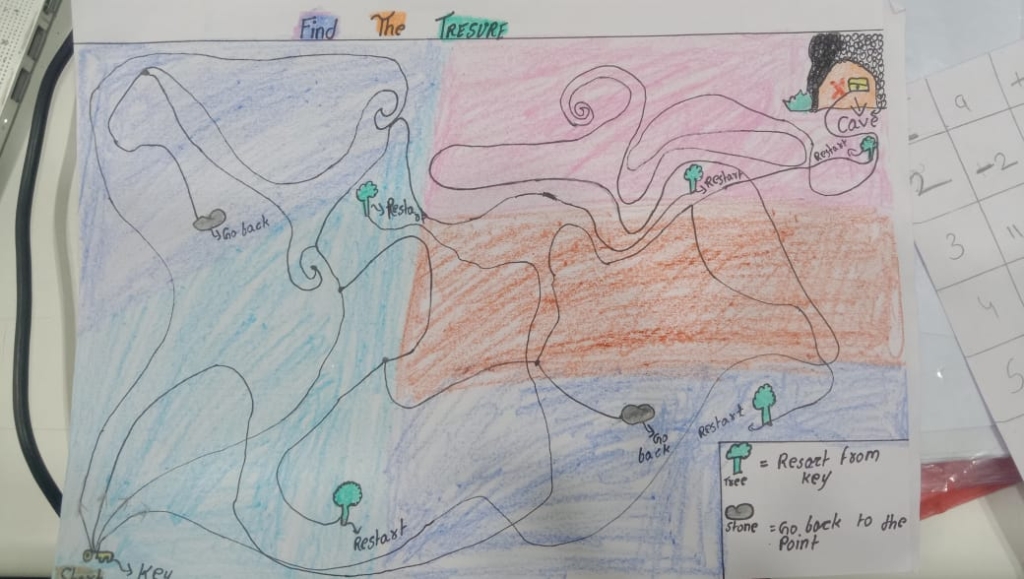
This game design activity wasn’t limited to one school. Across Mumbai, students in 12 different schools participated in this creative challenge as part of our play programmes. Each group developed a unique game that reflected their ideas and teamwork. Here’s a glimpse of the games they created:

Match the Card

Grade 6 – MHB Urdu School No. 1
In this memory-based game, players must match pairs of cards. All cards are shuffled and laid face down. Players take turns flipping over two cards at a time. If the cards match, the player keeps the pair and gets another turn. If they don’t match, the cards are turned back over, and the next player takes a turn. The player with the most matched pairs at the end wins.

Shark Attack

Grade 7 – MHB Urdu School No. 1
This exciting elimination game keeps players on their toes. A pile of chits — small slips of paper — is prepared, with most being blank or marked safe, and one featuring a shark. All the chits are tossed into the air or laid out face down. Each player picks one at random. The player who picks the chit with the shark is immediately out of the game. The remaining players repeat the process with the remaining chits, continuing round after round. The game goes on until only one player remains — and that player is crowned the winner. Simple, quick, and full of suspense. 

Scale Ludo or Ludo Climb

Grade 8 – Govind Nagar Hindi School
Ludo Climb or Scale Ludo is an exciting twist on the classic Ludo game, designed to test both luck and strategy. Instead of traditional numbered dice, players use a special dice marked with plus and minus signs. The game is played on two vertical scale boards, where players either move up or down based on their dice roll. A plus sign lets the player climb higher, while a minus sign pulls them back down the scale. The challenge is to navigate the ups and downs and be the first to reach the top — known as the “head” — to win the game. With its unpredictable moves and race-to-the-top format, this game adds a new layer of excitement to a familiar favourite.

The Way Home

Grade 8 – Govind Nagar Hindi School
The Way Home is a journey-themed board game where players must travel through exciting checkpoints — a cave and a lake — before reaching the final destination: home. The path is set, and every player must visit all the key locations in the correct order to move forward. Skipping a checkpoint isn’t allowed, adding an extra layer of strategy. The first player to successfully complete the entire route and reach home wins the game. 

Oops! Ladder

Grade 6 – MHB Urdu School No. 2
Oops! Ladder is a fun and tricky version of the classic Snakes and Ladders. To start the game, players must roll a 3. If you roll a 4 during the game, you have to move 4 steps backward. The board also has surprise spots — if you land on a number that ends in 0 (like 10, 20, or 30), you go all the way back to the start. Landing on a number that ends in 5 (like 5, 15, or 25) makes you move 10 steps back. The game is full of unexpected twists, making it more exciting and challenging with every move.

Colour Clash

Grade 8 – Malvani Township English School
Colour Clash is a vibrant card game inspired by Point Salad, but with a twist — instead of vegetables, players collect colourful cards. Each card represents a different colour, and players must match them in specific combinations to earn points. The more strategic the match, the higher the score. The game encourages players to recognise patterns and think ahead while making quick decisions. With its bright visuals and simple rules, Colour Clash is a fun way to test memory and strategy. 

Countdown Race

Grade 8 – Malvani Township English School
Countdown Race is a thrilling board game where players begin at tile 80 and race their way down to tile 1. Along the way, special coloured tiles give players a boost — orange tiles move you 2 steps forward, pink tiles give you a big jump of 6 steps, and purple tiles add 1 step forward. Players must think carefully about their moves and use the colour boosts wisely to reach tile 1 first and win. It’s a fun mix of luck and strategy, with every move bringing players closer to victory.

Spinning Vegetables

Grade 8A – MPS CBSE Rajawadi School
This is a fast-paced observation game. A spinner indicates a colour, and the player has 15 seconds to find and name three items of that color. Successfully finding all three within the time earns points. The player with the most points at the end wins. The vegetables have been drawn as a guidance so the players get a nudge, incase they cannot think of anything from the respective colours. 

Find the Treasure

Grade 8A – MPS ICSE Dadar Wolen School
Find the Treasure is an exciting maze-based game where players embark on a journey to find hidden treasure. Players are given three possible paths to choose from, but beware — choosing the wrong path means you must start over. The challenge is to navigate the maze correctly and be the first to reach the treasure. It’s a game of luck and strategy, where every decision brings you closer to victory.

Fit and Play

Grade 7 – MPS CBSE Tunga Village
Fit & Play is a dynamic and healthy game that combines exercise with fun. Players shuffle blocks on a board filled with different exercise poses. Wherever the block lands, the player must perform the exercise shown on that square. The goal is to stay active and have fun while completing the different exercises. 

Do If You Can

Grade 7 – MPS CBSE Mithagar
Do If You Can is an action-packed game where players must complete various challenges to move forward. Using a deck of 31 cards, each labeled with a number, players draw a card and then refer to the challenge board to see what task corresponds to that number. The tasks range from physical activities to mental puzzles. Players must complete the challenge before they can continue in the game. It’s a test of skill, determination, and fun as players race to finish the challenges and become the winner.

These game-design sessions are more than just fun projects. They’re a way for students to explore ideas freely, express their creativity, and develop essential life skills. When children are given time, space, and guidance to create through play, they build a mindset that values exploration, teamwork, and growth.

IMPORTANCE OF PLAYPLAY2LEARNSAFE SPACE

How Play Fosters Inclusivity, Builds Confidence, and Connects Every Child

It was just another day at Deonar Colony, where a Toybank play session was underway. The room was buzzing with excitement and laughter, children busy in discussions, strategising, putting their best ideas forward on how to play the games to the best of their abilities. Among these children was Afzal, a determined Class 7 student. Afzal is a child with physical disabilities and finds everyday activities difficult. His classmates would not include him in games and this bothered Afzal, as he felt lonely. 

However, on a particular day, the power of play revealed itself in an extraordinary way.

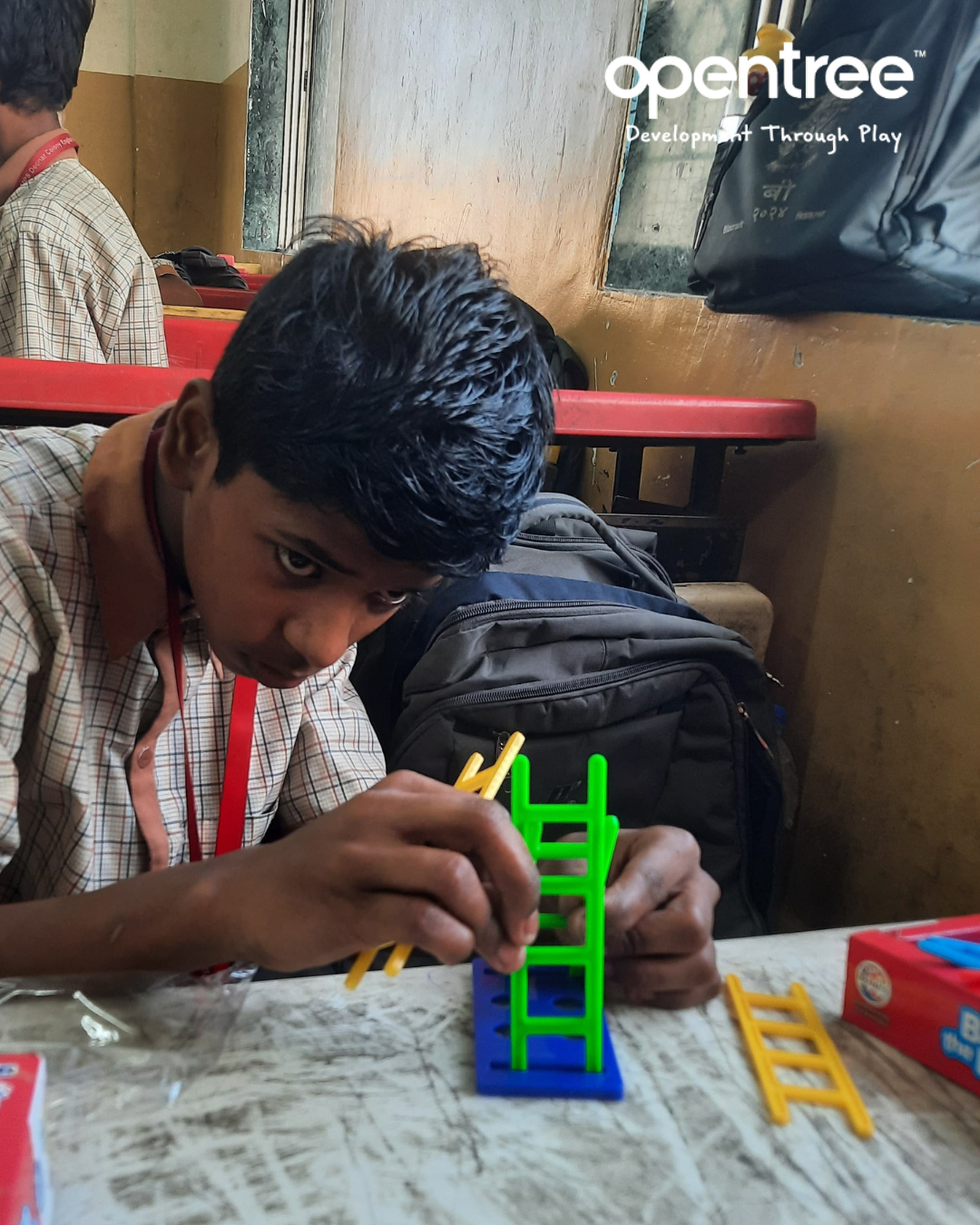
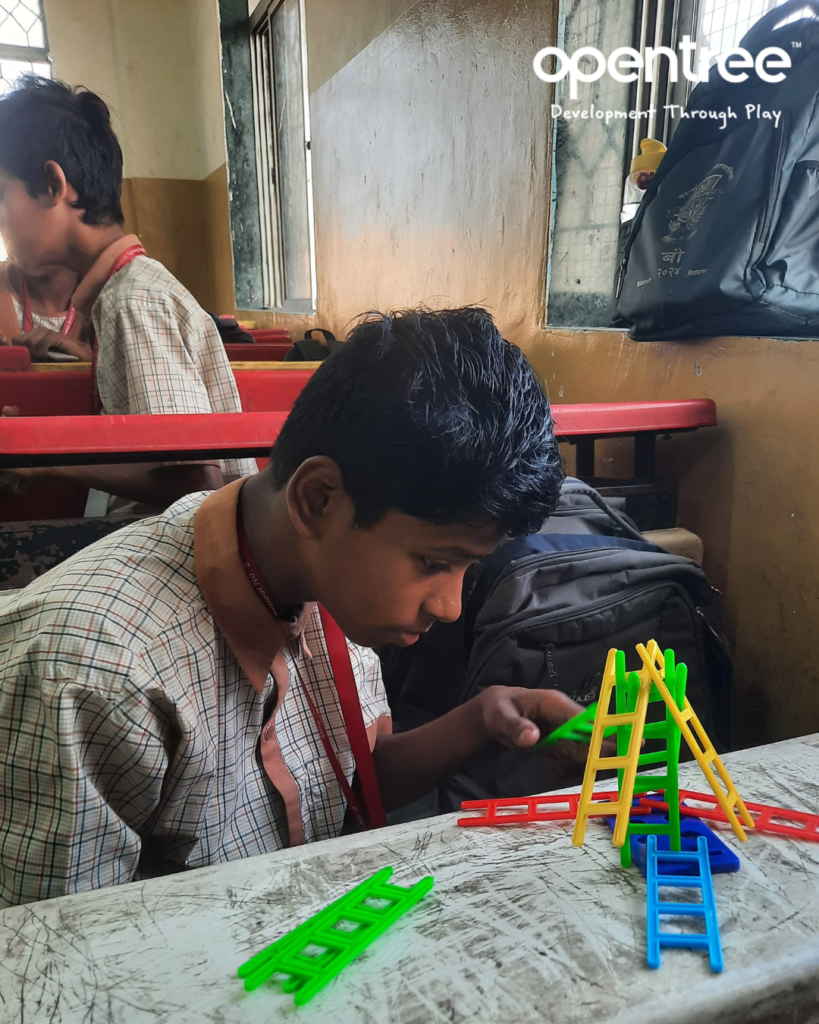
As the play session began, children eagerly rushed to the table of board games and play kits. Afzal stepped forward and asked our Outreach Play Worker if he could take a game that he could play by himself. He was handed Balance The Ladders — a game that requires precision and patience. It wasn’t easy for him. He tried, failed, and tried again. His first attempts ended in the ladder toppling over. But the game had sparked a desire to keep going. Play is a powerful motivator for children as it taps into their natural curiosity, creativity, and desire for joy.

Our OPW noticed this and offered support. Together, they managed to balance 10 ladders and Afzal’s eyes lit up. However, this time, he wanted to try it on his own. With a nod of encouragement, he picked up the pieces again. This time, his hands were steadier and his focus was sharper. One by one, more steps of the ladder stood tall.

The children around him began to take notice and many came forward to help. When he finally completed the game, the entire class applauded and this made Afzal feel joyous. The same children who once distanced themselves from Afzal now gathered around him and also welcomed him into the groups. Play had created a space for empathy to grow. The next time our OPW went to the class, he saw that Afzal wasn’t sitting alone, he was surrounded by friends, laughing and playing with confidence.

Through a single game, play had shifted perspectives. It gave Afzal a voice, a platform to shine, and a way to connect with others on equal ground. For the other children, it taught powerful lessons in resilience, kindness, and the importance of inclusion.